Proximity and Power

Boxing (1)

I begin by skipping rope.

tap     tap     tap     tap     tap

The rope taps briskly against the floor, slow at first as I warm up, calf muscles clenching and protesting before they ease into the rhythm. I count to 200.

tap   tap   tap   tap   tap

Faster now. 400.

tap  tap  tap  tap  tap

Faster still. 600.

tap tap tap tap tap

The rope just a blur. 800.

taptaptaptaptap

Until, breathless, I stop and toss the rope aside. 1000.

I roll my shoulders, loosen up. Start shadow boxing at the darkened studio window, my reflection jabbing back at me with the familiar unfamiliarity that haunts my mirror image. But this time I don’t try to fit those female fragments into a coherent structure – I ignore the body and watch the motion, each movement detached and isolated, mechanical and yet alive with a deceptive hidden power. And I can feel the gratitude snaking through those fluid lines of chest and shoulder, gratitude for this gift of graceful motion.

I pause to wrap my wrists and knuckles. Slip my hands into well-worn gloves, bite down on the velcro strap, jerk my head back to tighten the cuff – the sweaty synthetic taste of it somehow grounding. I turn my back to the window. Now it’s just me, my body, and the bag.

The bag is old and tattered. Several layers of tape mend tears in the fabric. Formerly cylindrical, the sides have been flattened by a decade of heavy beating. I have gained precision in my aim and timing, trying to land my punches on the flat faces as the bag rocks and rotates.

Boxing has been described as a romance of masculinity and as the most dramatically masculine sport. Certainly boxing can be an avenue of aggression and anger and violence. But this – right here, this moment – this has nothing to do with masculinity. This has nothing to do with anger. This has nothing to do with violence. It has everything to do with peace: finding peace in the strength and stamina of a beautiful body that my brain so often refuses to accept.

I am the only female-bodied person in the gym. I can hear loud groans and heavy grunts from the men lifting weights across from me, perhaps from genuine exertion but more likely from their sense of entitlement, their unquestioned privilege to demand attention and invade even the auditory space. But my space – my sweaty ring around the swaying bag – is silent up until the split second of contact.

The sound of each strike cracks the silence. The impact of each punch echoes through my body as I pull back to hit again. The lyrics of this music thrum through my mind and hum through my muscles.

Jab
Crack

Jab
Crack
Cross
Crack

Breath
Shuffle back
One two
Rear hook
Crack

Breath
Head flicks
Sweat flies

Jab
Crack
Cross
Crack
Jab
Crack
Uppercut

Breath
Shuffle forward
Breath
Sweat drips
Breath

Lean in
Leap back
Duck
Jab
Crack
Jab
Crack
Jab
Crack
Cross
Crack

Breath
Breath
Breath

The bag is swinging wildly now. I must have fallen just a little out of tempo. Thinking too much. My body knows what to do if my mind doesn’t interfere. I step forward, cradling the heavy bag in my arms, letting my body absorb its momentum, ushering it gently back to stillness. I hear a cranky metallic clank from the chain suspending the bag. I stay there for another second, my face pressed against the fabric, a rough seam digging into my cheek. Then I shuffle backwards, tap the bag with one curled glove – respect, dear friend – and begin again.

Boxing is not about masculinity.

Boxing is a dance.

Boxing is a dance
of proximity and power,
of precision and peace,
of silence and space,
of gratitude and grace.

Our lives
Are better left to chance
I could have missed the pain
But I’d have had to miss
The… dance…
– Garth Brooks (The Dance, 1989)

The Madam and the Gentleman

The Madam and the Gentleman (1)

I was inspired to write a Genderland version of The Walrus and the Carpenter (Lewis Carroll, Through the Looking Glass and What Alice Found There, 1871). 

The madam and the gentleman
Were walking through the trees.
Or were there two gentlemen?
Two madams, possibly?
So matched were they in character
And wit and empathy.

It was only where the leaves
Grew sparse that you could see
His breadth, her breasts, such superficial
Difference in anatomy.
But still their voices rose and fell
In lovely harmony.

Said he to her, “My dear, it’s grand
To have a friend at last.
I hate to let myself remember
Such a lonely past.”
Joining hands, they walked along,
Barefoot on the grass.

Said she to him, “It cost your rib
To make me as I am.
So to you, I give a name – I think
It should be Adam.”
They shared a smile, hand in hand,
The gentleman and madam.

The sun began a slow descent
A wind blew through the trees
Said he to her, and pulled her close,
“I shall call you Eve.”
Their arms around each other dulled
The coolness of the breeze.

Side by side they passed the night
And woke to beads of dew
Shining softly on their skin.
He said, “I dreamed of you.”
They stood and shook the dewdrops off.
She said to him, “Me too.”

“We are together when we dream
And also when we switch
To consciousness,” said she to him.
“I can’t tell which is which.
Both are paradise, it seems
I am pleasantly bewitched.”

Awake and warming in the sun
They wandered hungrily
Along a narrow winding path
And found an apple tree
With burdened branches stretching out
As far as they could see.

They marvelled at their fortune.
“What good luck,” he said.
He reached and plucked an apple
From just above her head.
It hung there, heavy in his hand,
Shiny, ripe, and red.

She reached too but pulled back, startled
By a toothy emerald grin.
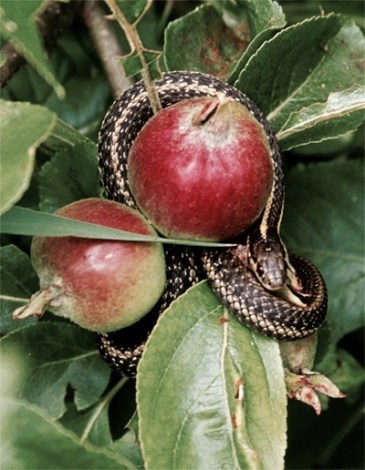
Along the bough, a serpent slithered
Small and green and thin.
It said, “Go on and take a bite
One bite is not a sin.”

“But,” it hissed, “if you do bite
This is what I’ll do…”
Its restless tail twitched back and forth.
“I’ll make a list of rules
That will divide your perfect pair
Into a separate two.”

Said she to him, “I shall not bite
For us, I really daren’t.”
But he pressed the apple to his lips
His appetite inherent.
The serpent hissed in satisfaction,
Its victory apparent.

Hunger sated, horror dawned, he said
“What have I done, my dear?
I’ve consigned us to convention
For all the coming years.”
She sadly sighed and shook her head
And shed a bitter tear.

To him, the snake said, “You must always:
Defend your fragile pride.
All your affection and compassion
You will be forced to hide
Behind anger and aggression and
Your bulging muscle size.”

To her, the snake said, “Your rules are:
You cannot upstage him.
Be meek and mild and obliging
So you do not enrage him.
And above all, mark my words,
Your beauty must engage him.”

The serpent, sly and treacherous,
Alive for centuries,
Hissed and blinked its beady eyes
The better for to see
These two friends lose each other
In archaic binary.

Said she to him, “How can we now
Ever stand a chance?”
They felt the weight of expectation
Pushing them askance.
Resigned and rueful, their eyes met
In a final silent glance.

Now the madam and the gentleman
No longer hand in hand,
A sneaky snake that whispers lies
To a woman and a man,
And a poisoned apple tree are all
That’s left of Genderland.

Not A Simple Question

Ashes

There are numerous articles and blog posts discussing the many ignorant, intrusive, and inappropriate questions that are all too often aimed at transgender people. These articles are on popular websites (Everyday Feminism, BuzzFeed, Astroglide, Huffington Post, Cosmopolitan, Autostraddle), as well as on personal blogs written by trans people (janitorqueer, American Trans Man, Matt Kailey’s Tranifesto). There are even artistic projects devoted to this issue (A Series of Questions). There are differences within the trans community regarding willingness or unwillingness to answer these types of questions, depending on their relationship with the asker, the context in which the questions are asked, their desire for privacy, and the extent to which they want to educate others. I will not rehash what has already been discussed so extensively on other sites.

But, from here in my small corner of the internet, I would like to add something to this ongoing conversation. This is a question that I have not seen mentioned in any of the existing articles, but one which I have heard multiple times and have always found difficult to deal with:

“Which is harder, coming out as gay or coming out as transgender and going through transition?”

In my more generous moments, I want to believe that people who ask this question are making an honest attempt to use an experience they think they understand (coming out as gay) to provide a frame of reference to help them understand an experience that seems more foreign (coming out as trans and going through transition). In a neutral frame of mind, I might view this question as the idle curiosity of an interested audience. But I cannot ignore the dismissive presumption inherent in that question, the way those words reflect a simplistic desire to neatly rank and categorize unfamiliar experiences along a linear scale of difficulty, the way those words erase the incredible diversity of individual experiences with the assumption that one person can speak for everyone who is gay and everyone who is trans.

So whenever someone asks me that question, I feel an odd mixture of anger and resentment conflicting with my effort to be tolerant and give them the benefit of the doubt regarding their intentions. I could choose not to answer the question. But so far I have always chosen to answer, because my desire to be understood exceeds my desire to disengage.

“Which is harder, coming out as gay or coming out as transgender and going through transition?”

This is what I say to people who ask me this question: I think the question is irrelevant and impossible to answer. Each person’s situation is so different. The challenges each individual faces and the distress they experience are dependent on so many complicated factors: their social support system, their home and work environments, their personality, concurrent physical or mental illnesses, economic status, race, perceived gender, the list is long. And I think perhaps one of the most powerful factors influencing LGBT experiences is a person’s own acknowledgement and acceptance of their sexuality or gender identity. The internalized homophobia and transphobia generated by a lifetime of societal conditioning can create such deeply entrenched and overwhelming shame – shame like a slow-burning bonfire that eats away at the edges of your soul until you are entirely consumed by the raging heat.

Speaking only for myself: the constant physical dysphoria that comes from living in a female body with a brain that resists this body so intensely – this incongruence made so glaringly evident in every mirror, every motion, every moment – and the physical effects of the hormonal and surgical aspects of transition are a notable difference between my experience and the experiences I’ve heard gay friends describe. The physical aspects of gender dysphoria and my fears and uncertainties about the medical aspects of transition are more disturbing to me (though no less important) than my fears about the social repercussions of transitioning.

Speaking once more for myself: despite the physical distress that is so painful, my journey so far has allowed me to accept gender dysphoria, authentically and shamelessly, as part of who I am. My shame has stopped burning and now I sift through the ashes to reassemble the charred pieces of myself. And though my landscape still looks bleak and scorched, I get to decide where I go from here. This acceptance has given me an extraordinary freedom that many trans people and gay people have not yet achieved if they remain burdened with shame or denial. For this part of my experience, I have the utmost gratitude.

“You ought to be ashamed of yourself for asking such a simple question.”
– The Gryphon (Alice’s Adventures in Wonderland, 1865)

Never Just Black

Never Just Black

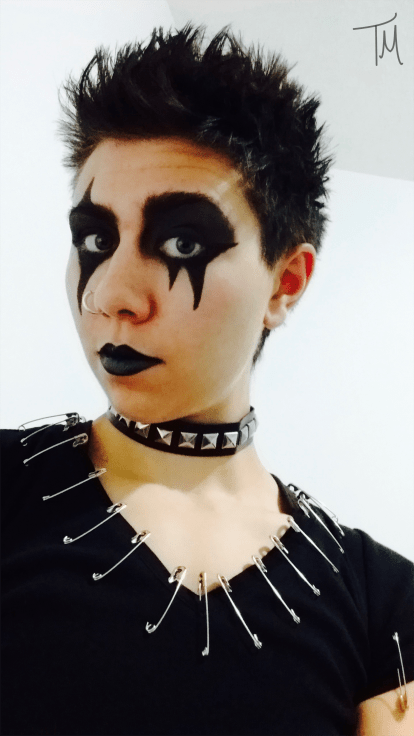
This past October 31 marked the first time I dressed up for Halloween in over half a decade. For years I had avoided dressing up and declined my friends’ Halloween party invitations because I could not tolerate the way that a costume would draw more attention to my physical appearance. I wanted my female face and female body to remain as invisible as possible. But thanks to my workouts and weight loss and more frequent male pronouns from strangers, I finally felt physically comfortable enough to consider a Halloween costume. When my manager encouraged employees to dress up at work, I wanted, for once, to be a good sport and join the fun instead of hiding behind lame excuses for my lack of Halloween spirit.

So I called my sister from a dollar store the day before Halloween, needing her help to navigate the dizzying rainbow array of pretty paints and powders. This was the first time I had ever worn real makeup and I had no idea what I was doing. “So you’ll probably want to go for the pencil eyeliner, it’s easier to work with than the liquid brush which can get kinda messy if you don’t have a lot of practice… but maybe get both and see which one you like better?” she said. She doesn’t wear cosmetics on a regular basis, but she has a lot of practice doing stage makeup from her days in ballet and cheerleading. “And you should probably get some lip liner to give your lips a defined outline, especially if you’re going with cheap lipstick which tends to smear.” All excellent advice. $15 and a few hours later, she coached me through my clumsy first attempts at applying all these products. My face was raw and red from rubbing off all my mistakes. But if I was going to dress in drag – compared to my usual androgynous attire, wearing makeup and a tight T-shirt and a short skirt seemed as deliberately flamboyant and exaggeratedly feminine as drag costumes – well, I was damn well going to do a good job of it.   

Despite the frustration of several failed attempts, I ended up enjoying the process of painting my face. As an artist (many years ago), black was always my favorite color. Black – pure, plain, unadulterated black – is dull and flat and lifeless. But black enhanced with hints of other colors – it becomes an enchanting dark dimension. So in my artwork, black was never just black. And on my face it was the same, purples and reds blending beautifully into the black eyeshadow and black lipstick.

The fact that I had so much fun with my costume was unexpected. Also unexpected was the way this makeup mask made my mirror image temporarily comfortable. Usually when I catch a glimpse of my face in a mirror, a flash of unsettling unfamiliarity floods those first few moments. But with such ostentatious makeup, that feeling of detachment from my own reflection suddenly had a perfectly coherent explanation, which made me feel strangely comfortable with the unfamiliarity of that painted face staring back at me.

“A large rose tree stood near the entrance of the garden: the roses growing on it were white, but there were three gardeners at it, busily painting them red.”
– Lewis Carroll (Alice’s Adventures in Wonderland, 1865)

Zero Dollar Haircut

Zero Dollar Haircut (Final)

As I get closer to my appointment to start hormone therapy, I have been forced to confront one of my biggest fears regarding testosterone: hair loss, also known as male-pattern baldness or androgenetic alopecia. I have been reluctant to admit this fear of hair loss, even to myself, because it seems like such a minor and superficial concern compared to so many other aspects of hormone therapy and gender dysphoria. I have been uncomfortable accepting that this fear is largely driven by vanity. I would like to think I am above such petty obsession with external appearance. But the intensity of my fear of hair loss suggests otherwise. So I have investigated strategies to prevent – or at least minimize – the extent of hair loss while taking testosterone.

Androgenetic alopecia affects approximately 50% of cisgender men by age 50 and approximately 90% of cisgender men in their lifetime (Kabir 2013). One study demonstrated that among Caucasian cisgender men, androgenetic alopecia was present in approximately 50% of those 30-35 years old, 60% of those 36-40 years old, and 70% of those 40-45 years old (Shankar 2009).  Androgenetic alopecia is less prevalent, but still relatively common, among cisgender men of other ethnicities (Feinstein 2015). Men with visible hair loss are perceived as older and less physically and socially attractive (Mella 2010). The prevalence of androgenetic alopecia in female-to-male transpeople (FTMs) is similar to that for cisgender men, occurring in approximately 50% of FTMs after 13 years on a physiologic dose of testosterone (Fabris 2015, Gooren 2008, Meriggiola 2015).

Androgenetic alopecia is influenced by hormonal factors. Testosterone is converted to dihydrotestosterone (DHT) by the enzyme 5-alpha-reductase. DHT has five times greater affinity for androgen receptors than testosterone. Hair follicles in the scalp produce 5-alpha-reductase which converts testosterone (produced elsewhere in the body) into DHT (which acts locally in the scalp). When DHT binds to androgen receptors on hair follicles, it results in a shortened anagen phase (the phase of hair growth) and decreases hair follicle size. This ultimately results in follicular miniaturization and the growth of shorter, thinner hair shafts. As more and more follicles undergo miniaturization, hair coverage of the scalp progressively decreases (Kabir 2013). Genetic factors also play a role. Androgenetic alopecia seems to be highly heritable, with complex polygenic inheritance and variable penetrance. Hair loss is more extensive in men with a genetic predisposition for greater numbers of androgen receptors on hair follicles and/or increased sensitivity of follicles to the effects of DHT (Kabir 2013).

One strategy to minimize hair loss that has been mentioned occasionally in articles about testosterone therapy is concurrent administration of finasteride. Finasteride selectively inhibits the 5-alpha-reductase enzyme, which decreases the concentration of DHT in the scalp and in the blood by approximately 60-70%. Because it reduces the amount of DHT, finasteride prevents or reverses hair follicle miniaturization as demonstrated in scalp biopsy studies (Mella 2010). Finasteride can be taken orally at a recommended dose of 1mg/day; studies have not demonstrated greater improvement in hair growth at higher doses (Mella 2010). Reported side effects of finasteride in cisgender men include decreased libido, erectile dysfunction, and ejaculation dysfunction; all of these side effects are very rare (Mella 2010). Presumably, erectile and ejaculation dysfunction would be of little concern in transgender men, even those who have had phalloplasty (given the current anatomical limitations of that surgery). Side effects of finasteride that are relevant for transmen include slowed or decreased growth of facial hair and body hair, and slowed or decreased clitoromegaly (TransHealth UCSF 2016). The blog American Trans Man has a post describing finasteride in more detail (Beards, Baldness and What’s in Your Pants).

Since I was a small child, my hair has been the source of great pride for me and much friction between my mother and I. For years I begged her to let me cut it short, but she refused on the grounds that it would make me “look like a boy.” She didn’t seem to understand that looking like a boy was precisely what I wanted. When she finally and reluctantly relented in 2006 and allowed my 14 year old self to get a short haircut, my hair became one of the first and one of the most important ways for me to exert some small measure of independence from my parents. Now that I am 24, my haircut is one of the only healthy ways I can modify my body and create a more masculine physical appearance to ease chronic physical dysphoria. (Obsessive exercise, excessive dietary restriction, self-induced vomiting, and painfully tight clothing are other strategies that I rely on to maintain a sufficiently masculine appearance but obviously I do not recommend these strategies).

For me, short hair is not just about gendered physical appearance. It is also about practicality. I hated long hair! I hated having to wash all that hair every evening in the shower. I hated having to towel-dry the soggy dripping mass. I hated how it took so long and hurt so much to comb out all the knots. I hated the way long tendrils of hair would end up everywhere – everywhere! – coiled in the shower drain, stretched out on my pillow, draped across my keyboard, poking out between the pages of a textbook like a tiny thready bookmark. I hated putting my hair in a ponytail, always conscious of the irritating tension, unsettled by how the sleek flatness of the pulled-back hair left my face so stark and open, like a picture without a frame. But I also hated leaving my hair free from the ponytail elastic, when it became a heavy hanging curtain that obscured my view and insisted on creeping into the corners of my mouth, my hands perpetually occupied in batting it away.

When I got it cut short, all those long-hair annoyances vanished. Then the only problem was that to maintain a shorter style, haircuts become necessary more frequently. The one advantage of long hair was that I only needed a haircut once or twice a year. My short style required a trim every eight weeks. I hated haircuts. I hated the inconvenience of having to schedule an appointment or waiting as a walk-in with nothing to do but browse through battered People magazines. I hated that I always gave the stylists the same description of what I wanted and got different cut every time.

I scrupulously avoided developing a long-term relationship with any of my hairdressers, taking pains to visit different salons on a rotating basis. Because once you’re beholden to one particular stylist then that’s it for you! No longer are you free to walk in whenever you choose – you have to make an appointment that works with their schedule, which is a chafing restriction of freedom for a busy person. No longer are you free to fend off small talk – you have to engage cheerfully and energetically to preserve this superficial relationship on good terms. After all, they are wielding sharp instruments in the vicinity of your jugular veins. No longer are you free to tip according to the quality of service – you now feel compelled to tip extra to ensure ongoing consistency in the style they deliver, tip extra to appear appreciative that they remember the random details of your life that they’ve extracted from you during reluctant small talk.

How I hated salon small talk! My silent salon-chair prayer: I’m paying you to cut not talk, so please, leave me be, focus on my hair, I don’t have anything to say. But stylists are relentless conversationalists, far more skilled in the art of superficial niceties than my awkward introverted self, leaving me always feeling two steps behind in a complicated and unwanted dance. “Ohmygod, has anyone told you how much you look like Miley Cyrus? No. No, they haven’t. But we’re both female-bodied and we both have short hair so yeah, we’re, like, totally twins. Please. Do shut up. So do you have any plans for the weekend, hon?” No. Well yes, but not plans I want to share with you. “Are you planning any fun vacations this summer, sweetheart? Gonna travel somewhere nice?” No. I don’t take vacations and I don’t travel. And if I say so, this is just going to get more awkward. “Are you excited for grad? Have you picked out your prom dress yet?  You must be so excited!” No. I graduated from high school eight years ago and when I did, I wore pants. And, worst of all, “So where do you work?” Usually I avoided that question by being deliberately vague. But if, caught off guard and overwhelmed by social anxiety, I admitted the truth – that I recently graduated from veterinary school – I would inevitably hear about her friend’s cousin’s English Bulldog – or maybe she’s a French Bulldog? you know I never can remember the difference, dear – anyway, she has terrible dermatitis and do you think it could be a food allergy and should he try feeding her a strict diet of carrots and cottage cheese?

What I hate most of all – with a cold, hard, brittle anger – is the fact that women’s cuts cost more than men’s cuts irrespective of style and complexity. This is true even at bargain hair salons (Ultracuts: women’s cut $17.95, men’s cut $15.95), with the price differences exaggerated in higher-end salons (Euphoria: women’s cut $35-55, men’s cut $30-35). What epic bullshit this is! Not only is this pricing unfair and discriminatory, it is completely ridiculous considering that many women’s haircuts require little more than snipping a half-inch off the ends while men’s haircuts typically involve more extensive shaping and require the use of multiple tools (scissors, clippers, texturizers).

With all of these frustrations, the hair salon ordeal eventually became untenable. So I finally tried – with excitement and trepidation – to cut my hair myself. It was awkward and slow at first, trying to align the movements of my hands with the reverse image in the mirror, trimming conservatively in case of mistakes, making a hairy mess all over the bathroom counter. But I my system perfected now: #3 clipper guard (3/8 inch) on the sides, #4 guard (1/2 inch) to taper the sides into the top, scissor cut the top and bangs with practiced precision… and then the back, usually a #6 guard (3/4 inch) to leave it long enough to create a wide fauxhawk, but sometimes I let the back grow out for a few months into a baby rat tail (my dad says this looks like a mullet – business in the front, party in the back – but I say it’s a party in the front AND a party in the back).

I love cutting my hair. I love the feeling of accomplishment and competence when I see the finished product – damn girl, you did that! I love how it looks exactly as I had envisioned. I love the way the messy locks have a cocky character all their own, the way they frame my face in a way that feels so right. I love having the freedom to give myself a trim as soon my hair crosses my threshold of intolerable shagginess. I love the way the clippers feel moving across my scalp, the way the soothing vibration seems to penetrate all the way through to my brain. I love the way it feels when clumps of hair – spiky little dark brown mice – drop from the clipper blades onto my bare shoulders. I don’t even mind sweeping up these scattered clumps with my hands, flushing them down the toilet, vacuuming the bathroom afterwards. And I love how my mother hates my haircut. Perfect.

It is tempting to romanticize my hairstyle preference as an essential means of expressing some intransigent gender identity. I could perhaps pretend that my gender-non-conforming haircut has some important political significance, that it is a follicular feminist statement. If it were any of these things, my fear of hair loss would have a lovely self-righteous justification. But if I’m honest, I’d say my hair has no real significance beyond this simple fact: I love it. I love how it looks. I adore the feeling of my fingers running through the fresh-buzzed stubble. I enjoy the way the wind chills my exposed ears and naked nape, the way the breeze ruffles the hair on top like a friendly hand. If this is vanity, then fine – I’ll own that. I am vain. We all are, in different ways for different reasons. So I will explore the option of finasteride with an authentic shameless vanity.

Cordless hair clippers: $49.95
Haircut: $0
My hair my way: *priceless*

“Your hair wants cutting!”
– The Mad Hatter (Alice’s Adventures in Wonderland, 1865)

————

References

Fabris B, Bernardi S, Trombetta C. Cross‐sex hormone therapy for gender dysphoria. 2015. Journal of Endocrinological Investigation 38(3):269-282.

Feinstein RP. Androgenetic alopecia. 2015. Medscape Drugs and Diseases. Accessed online 26-04-2016.

Gooren LJG, Giltay EJ. Review of studies of androgen treatment of female-to-male transsexuals: effects and risks of administration of androgens to females. 2008. Journal of Sexual Medicine 5(4):765-776.

Kabul Y, Goh C. Androgenetic alopecia: update on epidemiology, pathophysiology, and treatment. 2013. Journal of the Egyptian Women’s Dermatologic Society 10: 107-116.

Mella JM, Perret MC, Manicotti M, et al. Efficacy and safety of finasteride therapy for androgenetic alopecia: a systematic review. 2010. Archives of Dermatology 146(10):1141-1150.

Meriggiola MC, Gava G. Endocrine care of transpeople part I: a review of cross-sex hormonal treatments, outcomes and adverse effects in transmen. 2015. Clinical Endocrinology 83(5):597-606.

Shankar K, Chakravarthi M, Shilpakar R. Male androgenetic alopecia: population-based study in 1,005 subjects. 2009. International Journal of Trichology 1(2):131-133.

TransHealth UCSF. Primary care protocol for transgender patient care: hormone administration. Accessed online 26-04-2016.

Present Tense

Clock (1)

Depression has a curious way of disturbing the passage of time.

On depression’s terms, time  s t r e t c h e s . . .  o  u  t  .  .  .  s   o   .   .   .   s    l    o    w    l    y    .    .    .    with a maddening and mocking languidness.

Remembering and sequencing the events of today becomes an overwhelming challenge, my mind trudging grudgingly through the heavy fog that clouds those recent memories. The last few days and weeks and even years are stacked haphazardly, an inseparable scatter of all things past.

More cruelly, depression amputates the future. Tomorrow and next year are equally incomprehensible. This missing sense of future is deeply unsettling. It is like losing your peripheral vision – only when it’s gone do you realize, with horror! – how casually you took it for granted, how much it used to guide your behavior and perception, and how without out it you feel lost in a narrow and distorted world.

I have also seen these wrinkles in time described by people with terminal physical illnesses. Most eloquent of these descriptions was written by Paul Kalanithi in the days leading up to his death from lung cancer:

“Verb conjugation became muddled. What tense was I living in? The future tense seemed vacant and, on others’ lips, jarring. The future, instead of the ladder toward the goals of life, flattens out into a perpetual present. Money, status, all the vanities the preacher of Ecclesiastes described, hold so little interest: a chasing after wind, indeed.”

The relentless suicidal ideation that accompanies depression seems, in many ways, very similar to the last months of a fatal physical disease. To outsiders, the most salient difference between those two is the illusion of choice.

I think that a coherent sense of future can also be a casualty of gender dysphoria, especially for those of us with uncertain transition goals and unpredictable transition outcomes.

I have had a hard time visualizing my future, as either female-perceived or male-perceived. Needless to say, this is a bit of a dilemma, as it can create the sense of moving into an enigmatic, inconceivable oblivion. Now, I don’t think it’s healthy to focus too much on the future, but I do think it’s normal to have some sort of future projection of yourself to hold onto – and I think that’s something that transgender people are plagued with – with not being able to visualize their future self during uncertain times, particularly when they are considering medical intervention.” – gendermagik

The point where depression and dysphoria intersect is a terrifying discontinuation of the mental and the physical, an inescapable Möbius strip of mind and body locked perpetually in the painful present tense.

The broken clock is a comfort, it helps me sleep tonight
Maybe it can stop tomorrow from stealing all my time
I am here still waiting, though I still have my doubts
I am damaged at best, like you’ve already figured out
– Lifehouse (Broken, 2007)

“You do not get the time back. Whatever time is eaten by a depression is gone forever. No matter how bad you feel, you have to do everything you can to keep living, even if all you can do for the moment is to breathe. Wait it out and occupy the time of waiting as fully as you possibly can. Hold on to time.”
– Andrew Solomon (The Noonday Demon, 2001)

I Doubt It

I Doubt It Shower (1)

I had been dealing with depression for several years before I started exploring gender transition options. Of course, the distressing incongruity between my female body and my brain’s non-female body map had been extreme and persistent since puberty, but I tried so hard for so long to suppress those feelings, to attribute them to the body image disturbances that characterize anorexia nervosa or dismiss them as an unusual form of gender-centered vanity. So it was not until more recently – thanks in large part to perceptive suggestions from an observant friend – that I learned about gender dysphoria and started considering transition in a personal context.

When I first became aware of these options, I felt an immediate and expansive euphoria, an ebullient optimism that inflated me with such promising possibility. I believed that I had finally found The Answer to so many of my life’s uncertainties. I believed that transitioning – in a straightforward black-and-white line, from ugly A to perfect B, from female to male (whatever I thought those words meant then) – was The Solution that would fix all of my problems.

Buoyed by this excitement I began researching transition options, poring obsessively over online trans forums and frantically downloading research papers from PubMed. Very quickly I encountered cautionary statements – in scientific studies and trans peoples’ own stories – urging those of us considering transition to have realistic expectations about how transition may affect our life and reminding us that transitioning will not solve every problem.

“Overall, participants’ evaluation of the treatment process for sex reassignment and its effectiveness in reducing gender dysphoria was positive. It was described as a ‘‘challenge’’ or a ‘‘long and difficult road’’ that was worth taking because of its positive implications on future life, at the end of which not everything was different or better without limitations.” (Rupin 2015)

“Don’t expect transitioning to solve all of your problems. Transitioning is not a panacea – it won’t solve all of your problems. If you were prone to anxiety before coming out, you’ll probably still have to deal with it afterwards. At some point in my transition, I came to terms with the fact that living as my true gender wouldn’t magically fix everything. And it felt really good to let go of that impossible expectation.” – Annika

So I started to examine my own expectations about transitioning. This process began very gradually, my original optimism tempered but preserved. But as I delved ever deeper into myself, as I came to recognize – with a terrifying emptiness – that I do not have any cognitive sense of gender identity (just the physical distress associated with female anatomy), and as my long-standing depression spiralled ever further out of control, I started asking myself with a haunting and repetitive urgency: how much does gender dysphoria contribute to my depression? How much can I expect transitioning to alleviate this complex distress? These questions quickly gathered a frightening momentum, eliminating one by one every hopeful expectation I had about transition, culminating in a crushing avalanche of doubt about whether my gender dysphoria was even worthy of continued acknowledgment.

So often I would reach the end of the day and reflect on the past 16 hours, wondering what would have been better if I had lived the day inside a male body. Usually the answer that I gave myself was that very little would have changed, perhaps a few accidental mirror glimpses – always that initial flash of confusion as my brain works to reconcile reality with expectation – those mirror glimpses might have been less unpleasant, sure, but nothing else would have been any better. So why bother with transition then? Why bother with all this gender nonsense at all?

But in the moments when depression loosens – ever so slightly – its death-grip on my mind, in the moments when I feel a lucid clarity open up like a window to the world, I wonder if perhaps I underestimate how deep this dysphoria extends, if I underestimate how extensively the brain numbs itself to daily pain after a lifetime of unabated agony. And in these moments I can relive the day with more precision, sailing through the same sequence of events, but this time in a masculine vessel. It seems a lot would have been better.

On the squash court –
The squeak and shriek of sneakers on shiny varnished floor –
I could have worn shorts without feeling so self-conscious of my girl hips, I would not have been so painfully aware of my small shoulders dwarfed by the broad backs of male opponents, I would not have felt such desperate pressure to overcompensate with wins to prove that I deserve to play among men.

Standing outside in the summer sun –
The far-off chirp of cheerful birds and the low buzz buzz of busy bees –
I could have escaped my sweat-sticky sweater, an all-season mask concealing the feminine swell of my chest, and I could have instead felt the sun kiss the skin on my bare arms, I could have let my eyes wander as they wished without so consciously averting my gaze from the girl-shaped shadow on the ground.

In the shower –
Warm rivulets of water draining down over all the parts that I pretend do not exist –
I would not have had to cloak myself in darkness, I could have soaped my bristly legs without thinking automatically that I should shave them, and stepping out afterwards I could have wrapped the towel around my waist and seen my face and my bare chest in the mirror and not had to look away.

Driving in my car –
My hand on the shift stick and wind breezing in through the open window –
I would not have had to angle the rearview mirror just so to avoid that quarter-slice of girl-face when I glanced upwards, I would not have had to tug my jacket down low enough to hide the width of my hips in the seat, and I could have sung along more freely with the radio with a deeper voice vibrating through the lines of my jaw.

Pulling on my pants in the morning –
The rustling of fabric and the brisk zip of the fly in chilly pre-dawn dimness –
The flatness of the crotch would not have been such a mocking emptiness, the snugness of the pants over my hips and thighs would not have been such an excruciating reminder, and when I looked down I would have seen a man in jeans instead of a girl in men’s jeans.

Sitting typing like I am now –
Quiet clickety clack, clickety clack, rat a tat tat –
I would not have to feel the tight X of bra straps across my back, I would not have to notice how my wrists and fingers on the keyboard seem so slight and feminine, and I would not have to be afraid of seeing my face reflected back at me in the laptop screen.

With all of that, how is it possible that I still doubt whether I should transition? Such doubt this is! It only seems to multiply as my mind paces the same well-worn path through the same worn-out questions. This doubt is an aggressive beast that feasts on self-reflection.

“Do you suppose,” the Walrus said,
“That they could get it clear?”
“I doubt it,” said the Carpenter,
And shed a bitter tear.
– Tweedledee (Through the Looking Glass and What Alice Found There, 1871)

————

References

Ruppin U, Pfäfflin F. Long-term follow-up of adults with gender identity disorder. 2015. Archives of Sexual Behavior 44(5):1321–1329.

Unrelenting Darkness

Unrelenting Darkness (1)

I recently spent three weeks hospitalized in a psychiatric unit for treatment of depression. In clinical terms, I have severe chronic treatment-resistant major depressive disorder, a mouthful of words to describe a debilitating disease that has affected the trajectory of my entire adult life. My pharmaceutical history reads like a drug compendium, A to Z by generic name: aripiprazole, bupropion, caffeine, citalopram, clonazepam, desvenlafaxine, dexamphetamine, lisdexamphetamine, lorazepam, mirtazapine, oxazepam, trazodone, tryptophan, venlafaxine, vortioxetine, zolpidem, zopiclone. Over the past year in therapy, I have turned my soul inside out looking for answers, finding only a buzzing hive of angry stinging questions. But effort means nothing in the face of this monster. My brain just keeps attacking itself over and over, with ever shorter reprieves between recurrent nightmare episodes.   

My time in hospital was frustrating, necessary, and marginally helpful. I worked hard to create realistic expectations for myself after discharge and I was prepared to tolerate the distress arising during the initial readjustment to real life. But coming home from hospital has been unlike anything I have ever experienced before… I feel empty, hollow, completely gutted, broken beyond repair with a skull full of ugly scars, so far beyond hopeless that there are no words to describe this degree of detachment and despair. Since then I have been going through the motions of daily life, but that is truly all they are – mechanical motions performed perfunctorily to pass the time. I still adhere to the hospital schedule because it is the only structure I can cling to in the shattered remnants of my world: breakfast at 8:00, lunch at 12:00, dinner at 17:00, one pill at 19:30, another at 21:00. And when I’ve reached the end of each endless day, I have to fight through the night to snatch a few hours of disturbed and broken sleep.

I feel like I held on to my last shred of sanity while I was in the hospital, because I was focused on the short-term goal of getting discharged and because a smoldering filament of rage kept me connected, somehow, to the outside world. But now I have no goals, no anger, nothing, I’m just drifting in a completely meaningless void while the world keeps moving around me.

This depression feels like a brain tumor that has been growing for six years, slowly at first but ever faster as the malignancy multiples, gradually taking up more and more space inside my head and slowly choking off pieces of who I am. It has strangulated my motivation, eroded my energy, killed my capacity for hope. All I am left with now – and for how much longer I don’t know – is the capacity for gratitude, and a raw and feral intelligence caught in a leg-hold trap, thrashing ferociously and trying to chew off its leg to escape but unable to gnaw through the bone. And this toxic neoplasia continues growing faster than my acceptance of it, an escalating arms race, a Cold War in my brain.  There are no surgical options for treatment, no chemotherapy, not even any palliative means to ease this excruciating pain.

My psychiatrist, my sister, my friends – friends! such an inadequate word to describe these people that I love so fiercely – they encourage me so often to find things to be hopeful for. I try – I do – I try so hard – with infinite gratitude for their kindness and support – but I cannot manufacture authentic hope. It’s like being naked in a winter wind, trying to imagine what warmth feels like – even if you can conjure up the most vivid memory of hot summer sun, it will not prevent you from freezing to death.

I think the most powerful emotions are gratitude and hopelessness.  They both have the ability to eclipse all semblance of rational thought. They both leave me breathless in the wake of their intensity. And the two can coexist in a devious kind of harmony, like brilliant fireworks bursting in an unrelenting darkness.

Sometimes the curiosity
Can kill the soul but leave the pain
And every ounce of innocence
Is left inside her brain.
Shinedown (Her Name is Alice, 2010)

Twin

Twin

My parents have a small herd of Black Angus cows, small enough that they still name every calf born in the spring. Choosing names for the calves was always so much fun when we were children… until the year my younger sister named her steer calf Isabelle. I was shocked and horrified by her callous disregard for the unspoken but unquestioned rule that boys get boys’ names and girls get girls’ names, no matter what species of creature they are. I cried for a while, then tried to talk her out of such a ridiculous decision. But when she refused to change her mind, I promptly named my heifer calf John out of spite. So there, little sister.

It wasn’t until much later that I really started to question why our world divides first names into male and female, why we insist on saddling such innocent syllables with a gendered connotation. It began to feel so strange to hear expectant parents proudly recite two separate lists of possible names for their unborn baby, names for a girl and names for a boy, those two prenatal lists already hinting at a more sinister set of stereotypes settling into place while the fetal cells diligently divide and differentiate.

Had I been born with a tiny infant penis, a urethral ticket to a world of privilege, my name would have been Benjamin. Instead I was given the female name my parents found in a quiet grassy cemetery, my pregnant mother strolling with my father, visiting the graves of relatives, falling in love with my name on a headstone one row over. It is a beautiful lyrical name, it means “purple flower”, and it is so rare in North America that most online baby name databases do not even recognize its existence. It is a name that has garnered many compliments when I first introduce myself, a name that has been mispronounced a dozen different ways in a dozen different accents, a name that is more deeply and more permanently a part of me than a tattoo or a scar. I am neither proud of this name nor ashamed of it, I regard it with the neutral allegiance of 24 years of involuntary companionship. I withhold my name here only out of concern for privacy.

But as I explore the world of gender, I wonder if perhaps I have outgrown this name. Considering a name change comes with a confusing mixture of emotions: sadness about leaving one name behind, excitement at the prospect of choosing another, guilt that I am erasing the name my parents put so much love and thought into, fear that by choosing a male name I am simply reinforcing the gender binary that has been so damaging and restrictive my whole life. I want to make it clear that for me, gender dysphoria is an almost purely physical distress, centered around my body and the problematic anatomy that my brain resists so emphatically. For me, names and pronouns are merely a matter of semantics, relevant only to the extent that a stranger’s “sir” or “he” validates the masculinity of my physical appearance. The main reason I have considered changing my name is that, depending on the extent of my transition (which at this point remains uncertain), a female name will become confusingly incongruent with a male body in most public circumstances. Adopting a unisex or male name will make it simpler for me and for other people. Of course, the simplest thing is not always the right thing, so I continue to reflect on my motivations for choosing a new name. For many of my friends, my first name is irrelevant anyway, as they refer to me by my last name (McMurray) or by nicknames derived from my last name (mcmurr, Mac).

The list of names that I considered was drawn mostly from my favorite fictional characters: Peter (Pan), Jeremy (Finch), Dirk (Pitt), Owen (Meany), Jack (Reacher), Max (Rockatansky). But I kept circling back towards the name I used online for years before I even acknowledged transition as a possibility: Tom Sparrow. As a child I was intrigued by a story my parents told me about their wedding. They had a guestbook for guests to sign their name and record where they were visiting from. After the wedding, my parents found a signature in the book from someone they hadn’t actually invited, a Tom Sparrow from New York, New York. My dad suspected that his best man had written the pseudonym as a joke, but I always liked imagining that this itinerant stranger, Tom Sparrow, had actually crashed their wedding. And this story resonated deeply with my younger self because, like Tom Sparrow the wedding ghost, I so often felt like an invisible guest at someone else’s party. Tom Sparrow… the name was a quick little bird flitting restlessly through the thread of my thoughts. (I only recently found out that the name in the wedding guestbook was actually Todd Sparrow, I must have misheard it the first time my parents told the story, but it’s too late now because Tom has solidified in my mind over so many years).

So I tried using the name Tom in the few circumstances where people knew about my gender journey and did not already have a nickname for me. With one friend I started signing off my emails as Tom (thereafter double checking the name at the bottom of all my emails to avoid any awkward mistakes). I asked my psychiatrist to call me Tom. I introduced myself as Tom in therapy groups. The name Tom felt so strange and foreign in writing and out loud, so I gave myself nearly a year to get used to it. But the foreignness never waned and Tom continued sounding silly and contrived. Eventually – frightened by the mounting feeling of detachment from my name, frustrated by my continued uncertainty regarding transition, and struggling with severe depression related to other life circumstances – I stopped signing my emails to my friend and requested that my psychiatrist not call me any name at all. This namelessness was comforting initially, like the reassuring anonymity of a dial tone.

But namelessness was not sustainable forever, so I tried Thomas instead of Tom. And very quickly Thomas felt right. I’m not exactly sure why… perhaps the single syllable of Tom was too abrupt and harsh and Thomas has a softer sibilance, perhaps the formal tone of Thomas commanded more of my respect, perhaps I reached a more authentic acceptance of gender dysphoria and could then commit more fully to this aspect of transition, perhaps it was simply the passage of time and a thousand self-reflections that softened the shape of a new name.

So for now, I am Thomas, to myself (sometimes), to my psychiatrists, and to friends who don’t already have their own name for me – those cheerful nicknames that carry all the shared history of an ongoing friendship.

Thomas means “twin”, which has an appealing symmetrical symbolism. You see, I am twins in one body. I am two sexes, male and female – separated by time and perception, biology and convention – inevitably intertwined until death do us part.

“I know my name now. That’s some comfort.”
– Alice (Through the Looking-Glass and What Alice Found There, 1871)

Somebody Told Me

Somebody Told Me - Album Cover

This gender journey is a constant hopscotch between the past, the present, and the future; where I was, who I am, what I want. The past is a jumbled collection of pieces from a dozen different puzzles and rummaging through it all – with the cold clarity of retrospect – has allowed me to start connecting those pieces into images that finally make more sense.

One of those old puzzle pieces comes floating up from time to time on the radio, leaping through the speakers with a smile and a wink – hello darling, didja miss me?

Somebody Told Me was released in 2004, the second official single from The Killers’ debut studio album Hot Fuss.

Well somebody told me
That you had a boyfriend
Who looked like a girlfriend
That I had in February of last year
It’s not confidential
I’ve got potential –

I remember hearing this song so many times on the dusty bus ride to and from my junior high school. It became for me an anthem of potential, striking a chord that I could not then articulate. I was enchanted by the idea of a boyfriend who looked like a girlfriend, captivated by the aching naked androgyny in those lyrics, and I wondered – drawing circles in the dirt on the grimy school bus windows – if a girlfriend could ever, maybe, look like a boyfriend. And then the song would lean back down and taunt me with the possibility…

I said maybe, baby, please
But I just don’t know now
When all I want to do is try –