Not Applicable

Not Applicable

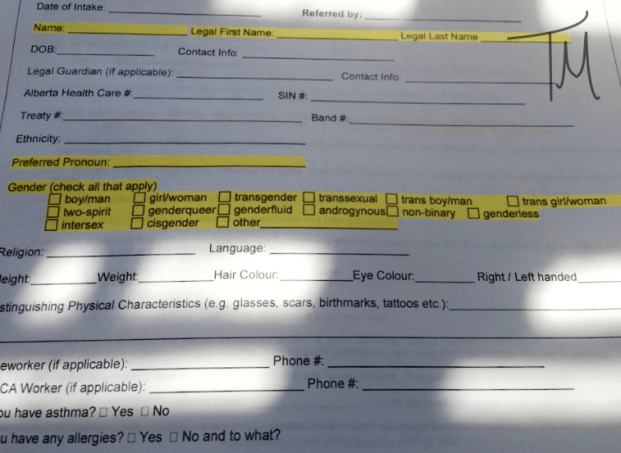
A friend sent me that photo of an intake form for a youth program. The list of check-box options in the gender section is highlighted, and the form also provides space for chosen name and preferred pronouns. Compared to so many of the forms and surveys that I fill out on a regular basis, the form in that photo shows an impressive list of gender options – far more inclusive than the standard “M” or “F”, and much more specific in the options offered than even the more ambitious forms that provide “other” in addition to the lonely M and and rigid F.

Some online arenas offer even more inclusive gender options, Facebook for example. Users were originally offered four gender options: male, female, private, or < no answer >. In February 2014, Facebook added a “custom” gender option for users in the United States, which included at least 58 different pre-populated gender options. This update also allowed users to choose their preferred pronouns. Facebook’s decision to expand their list of gender options was highly praised by the trans and genderqueer communities as a milestone of recognition and a beacon of hope. When this change was implemented for users in the United Kingdom in June 2014, the list of gender options had grown to more than 70. In August 2014, Facebook added gender-neutral options to describe family members. In February 2015, Facebook broadened their gender horizons once more, allowing an essentially infinite number of gender identity descriptors by providing a free-form field for users to fill in the blank.

Well done, Facebook. Here’s a round of virtual applause. Compared to paper forms, online forms have more versatility because they are not restricted by physical space. Given the physical restrictions that apply to paper documents, I very much respect the inclusive efforts made by the authors of the form pictured above. They also deserve a round of virtual applause.

Gender: check all that apply. Okay. Reading all the options listed on the intake form, I tried to imagine which ones I would check if I were filling out the form myself. I quickly became confused and frustrated. Every single one of those check-boxes could, perhaps – if stretched a little here and shrunk a little there – apply to me. And yet every single box feels as awkward and ill-fitting as an outgrown T-shirt. Nor was there any combination of boxes that could approximate a more accurate answer. After much fuming and deliberation, I eventually decided that I would check only one box: “other”. And then, on that inviting blank line, I would write “not applicable”.

Not applicable. These words are a defiant slogan for so much of the uncertainty in my life. Not applicable. These words are my defensive withdrawal from the identities it seems that other people understand and claim so easily. Not applicable. These words are a burden of crushing doubt and a window to a world of limitless possibility.

Gender: check all that apply. Gender: fill in the blank. Gender: why is it even included on so many forms? Asking for a person’s gender on a form, seems, in many ways, as irrelevant as asking for their favorite color. Color and gender are both vast supersets that include an infinite number of items, making it impossible – even ridiculous! – to attempt to define the answer within a finite series of boxes or on a single blank line.  Like favorite color, gender is constant and permanent in some people and fluid and changeable in others. Like favorite color, gender means quite a lot to some people and very little to others. And, like knowing someone’s favorite color, knowing someone’s gender tells you nothing about who they really are and merely conjures up in your own mind your perception of the label they chose. Some might argue that gender is directly relevant on forms related to medical or reproductive issues. I argue that even in a medical context, gender isn’t relevant – what IS relevant is the presence or absence of certain organs and the concentration of certain hormones in the bloodstream – haven’t feminists and LGBT advocates been fighting so hard for so long to challenge rigid binary assumptions that tie gender to biology? I would like to see Facebook’s increasingly inclusive effort taken one step further to remove gender entirely from the available fields on a user profile.

It has taken me a long time to develop this provisional (dis?)comfort with the words “not applicable”. And here’s a difficult confession: I don’t understand what gender identity is, I don’t know what it’s supposed to feel like, and I’m beginning to suspect that I don’t even have a gender identity. The chronic physical distress associated with the female features of my body remains the only indicator of gender dysphoria. When I first started exploring gender and considering transition to a more masculine body, I felt so confused and alienated by statements that surfaced so incessantly from famous trans people:

My brain is much more female than I am male. That’s what my soul is.” Caitlyn Jenner

I didn’t have to learn how to act like a man because in my head I’d always been one.” Chaz Bono

“I knew in my heart and my soul and my spirit that I was a girl.” Laverne Cox

“When I was four and began asserting myself as the girl I knew myself to be…” Janet Mock

Similar sentiments echoed from many FTM and MTF blogs. So often it seemed that even in trans discourse, the definitions of “man” and “woman” and “male” and “female” hinged on outdated stereotypes regarding socialized preferences and behaviors. I was left more bewildered than ever, wondering if I even deserved shelter under the trans umbrella given my lack of gender identity. This statement finally resonated with my own aching and unlabeled nonidentity:

“That really begs the question: what is a man? And what is a woman? And how much of that is societal bullshit anyway? None of the labels fit me. None.” iO Tillet Wright

Then I thought that reading about the experiences of people who identify as agender, bigender, genderfluid, genderqueer, and various other non-binary terms might feel more comfortable. But still I felt so estranged from those perspectives. I could not understand what often seemed like such an aggressive gender neutrality:

“I tend to paint my nails if I feel like I am going to be particularly expected to behave like a man. It creates a dissonance with expectations that I enjoy… I shop in the men’s and women’s sections, cobbling together a look that could confound the most attuned gender-assignment identifier from a few feet away.” Rae Spoon

It has never been my intent or my desire to deceive anyone with my androgyny. I also could not relate to the conviction that seemed to characterize many non-binary genders:

My gender is not all that unique or special. My gender is not all that queer or all that different. My gender is not rebellious. My gender is not something you should be jealous of… My gender is not about hating binaries. Really, the binaries are hating my gender. My gender is not about how limiting the binary is, and it’s not about liberating myself or anyone else from any binary… My identity is not about men or women. It’s about me, about how I understand myself, how I live my life, how others understand me, and what makes sense.” Kae

That statement sounds so enviously confident. But I don’t know what any of it means. It became more and more apparent for me that existing labels were, as ever, not applicable.

The comments about gender that have most accurately captured my own confusing experience come not from the trans or genderqueer community, but from insightful people on the autism spectrum. (Jack 2012)

“I was sailing blind through a world full of gender signals.” – Jane Meyerding

“I’ve never seen any purpose for genders. They don’t reflect anything real, since they take “this sex is likely to do this” and turn it into a set of rules, making “likely” into “has to”… and I don’t identify as either because of that. It’s arbitrary and doesn’t fit anything about me.” – BlackjackGabbiani

“i don’t consider myself to have any sort of “internal” gender identity whatsoever – it always feels like “gender” is simply not a valid category in which to place myself. When i see “gender” as a tick-box category on a form, i feel similarly to if, on a form asking for details of a vehicle, it asked for “miles per gallon” when my vehicle was powered by something completely different (and that can’t be measured in gallons), like say solar electricity – i just don’t really consider myself to belong to the category of beings that have gender.” – Shiva

The absence of gender identity, the utter inapplicability of gender as a concept for me, is so eloquently described in those comments. The article also describes how disorienting and painful this experience can be.

“For some autistic people, gender does not easily serve as an available resource for identity… for some individuals, gender disorientation can be emotionally painful and having a term to describe oneself can be tremendously important… the malign persuasion in question here might be the fact that lacking a term or word with which to identify might persuade people that they do not fit, that they are anomalous.” (Jack 2012)

“I’m upset because I feel like there’s no word to describe my gender expression. It’s probably silly to be upset about not having a word for something, but because I don’t feel represented in either straight or queer communities, I do have a desire to articulate what it is that I am.” – Amanda Forrest Vivian

However, even those statements do not incorporate the intense and distressing incongruence between my female body and my brain’s resistance to that body. This physical discomfort combined with the absence of any cognitive gender identity feels impossibly bewildering.

For me, “not applicable” extends even beyond gender to other areas that serve as important aspects of identity for most people. Most standard forms don’t ask respondents to classify their sexual orientation, but those that do almost universally fail to include “asexual” as an option. For example, one study described the survey used to gather data on a large population: “Sexual orientation was assessed with the question: “Which of the following best describes your feelings? (1) completely heterosexual (attracted to persons of the opposite sex), (2) mostly heterosexual, (3) bisexual (equally attracted to men and women), (4) mostly homosexual, (5) completely homosexual (gay/lesbian, attracted to persons of the same sex), or (6) unsure. Respondents were categorized according to their orientation identity as reported in that question.” (Roberts 2012) Had I filled out that questionnaire, I suppose I could have chosen “unsure”, but, in this context, unsure implies not an absence of sexual attraction but simply indecision regarding the other available options. In fact, only 3 out of 8968 respondents chose “unsure”, a mere 0.03%.

A different study specifically investigating the prevalence of various sexual orientations in the British population did include a category to represent asexuality. “The measure of sexual attraction was introduced as follows: “I have felt sexually attracted to…” Six options followed: (a) only females, never to males; (b) more often to females, and at least once to a male; (c) about equally often to males and females; (d) more often to males, and at least once to a female; (e) only males, never to females; and (f) I have never felt sexually attracted to anyone at all.” (Bogaert 2004) The results of the study showed that 1.05% of 18 876 respondents reported being asexual (“I have never felt sexually attracted to anyone at all”). The authors explain, “This rate [of asexuality] is very similar to the rate of same-sex attraction (both exclusive same-sex and bisexuality combined: 1.11%). However, binomial tests indicated that there were more gay and bisexual men than asexual men, and more asexual women than lesbian and bisexual women.” (Bogaert 2004)

Despite this data suggesting that asexuality is not only relatively common (1%) but actually more common than homosexuality and bisexuality among women, asexuality remains largely ignored as a legitimate sexual orientation. I am still hesitant and uncertain about claiming an asexual and aromantic identity, but these words seem like the best available descriptors for my experience. A big part of my difficulty in accepting an asexual or aromantic orientation with any confidence is that there is so much lingering uncertainty: how do you definitively confirm the absence of sexual and romantic attraction without really knowing what those things feel like? An asexual blogger eloquently described this distressing uncertainty:

“Perhaps the most insidious part of this is that, to some degree, asexuality is a provisional identity. Unlike other sexual orientations, which at least have a frame of reference for what sexual attraction feels like, asexual people must rely on guesswork. When other people figure out their orientations, they can look at specific incidents of attraction and behavior. But asexual people have to look for a void – how do you find a void? How can you know sexual attraction isn’t present, if you have no frame of reference for distinguishing it? You have to compare yourself to other people and make your best guess.”  – Anagnori

The authors of the first study that did not include asexuality in the survey (Roberts 2012) note that in their study, “People “unsure” of their feelings were excluded.” Somehow I feel like that exclusion of people who are uncertain about their sexual identity extends beyond the parameters of that particular study and applies broadly to the world at large. Sexual orientation: check all that apply. Sexual orientation: fill in the blank. Sexual orientation: not applicable.

Our culture emphasizes romantic love as a central pillar of happiness and the foundation of family structure. Our culture considers sexual attraction one of the most fundamental traits of being human – indeed, of being animal. Our culture pathologizes the absence of sexual attraction as a medical or psychological disorder. Our culture, while it has become somewhat more inclusive and more accepting of gender diversity, remains doggedly adherent to indefinable and irrelevant distinctions between “men” and “women”. Our culture insists that, while gender can sometimes bend the rules, it can never disappear. When these core beliefs and assumptions comprise the infrastructure of our society, being agender, asexual, and aromantic – imperfect descriptors for me but no better words exist – is an experience of profound invisibility. In most of the categories that my world deems important, I remain: not applicable.

“It’s exactly like a riddle with no answer!”
– Alice (Through the Looking-Glass and What Alice Found There, 1871)

————

References

Bogaert AF. Asexuality: prevalence and associated factors in a national probability sample. 2004. The Journal of Sex Research 41(3):279-287.

Jack J. Gender copia: feminist rhetorical perspectives on an autistic concept of sex/gender. 2012. Women’s Studies in Communication 35:1-17.

Roberts AL, Rosario M, Corliss HL, et al. Childhood gender nonconformity: a risk indicator for childhood abuse and posttraumatic stress in youth. 2012. Paediatrics 129(3):410-41

————

This post was awarded Tiffany’s Gender-Bender Award for May 2016.

Gender Bender Award Graphic

I Doubt It

I Doubt It Shower (1)

I had been dealing with depression for several years before I started exploring gender transition options. Of course, the distressing incongruity between my female body and my brain’s non-female body map had been extreme and persistent since puberty, but I tried so hard for so long to suppress those feelings, to attribute them to the body image disturbances that characterize anorexia nervosa or dismiss them as an unusual form of gender-centered vanity. So it was not until more recently – thanks in large part to perceptive suggestions from an observant friend – that I learned about gender dysphoria and started considering transition in a personal context.

When I first became aware of these options, I felt an immediate and expansive euphoria, an ebullient optimism that inflated me with such promising possibility. I believed that I had finally found The Answer to so many of my life’s uncertainties. I believed that transitioning – in a straightforward black-and-white line, from ugly A to perfect B, from female to male (whatever I thought those words meant then) – was The Solution that would fix all of my problems.

Buoyed by this excitement I began researching transition options, poring obsessively over online trans forums and frantically downloading research papers from PubMed. Very quickly I encountered cautionary statements – in scientific studies and trans peoples’ own stories – urging those of us considering transition to have realistic expectations about how transition may affect our life and reminding us that transitioning will not solve every problem.

“Overall, participants’ evaluation of the treatment process for sex reassignment and its effectiveness in reducing gender dysphoria was positive. It was described as a ‘‘challenge’’ or a ‘‘long and difficult road’’ that was worth taking because of its positive implications on future life, at the end of which not everything was different or better without limitations.” (Rupin 2015)

“Don’t expect transitioning to solve all of your problems. Transitioning is not a panacea – it won’t solve all of your problems. If you were prone to anxiety before coming out, you’ll probably still have to deal with it afterwards. At some point in my transition, I came to terms with the fact that living as my true gender wouldn’t magically fix everything. And it felt really good to let go of that impossible expectation.” – Annika

So I started to examine my own expectations about transitioning. This process began very gradually, my original optimism tempered but preserved. But as I delved ever deeper into myself, as I came to recognize – with a terrifying emptiness – that I do not have any cognitive sense of gender identity (just the physical distress associated with female anatomy), and as my long-standing depression spiralled ever further out of control, I started asking myself with a haunting and repetitive urgency: how much does gender dysphoria contribute to my depression? How much can I expect transitioning to alleviate this complex distress? These questions quickly gathered a frightening momentum, eliminating one by one every hopeful expectation I had about transition, culminating in a crushing avalanche of doubt about whether my gender dysphoria was even worthy of continued acknowledgment.

So often I would reach the end of the day and reflect on the past 16 hours, wondering what would have been better if I had lived the day inside a male body. Usually the answer that I gave myself was that very little would have changed, perhaps a few accidental mirror glimpses – always that initial flash of confusion as my brain works to reconcile reality with expectation – those mirror glimpses might have been less unpleasant, sure, but nothing else would have been any better. So why bother with transition then? Why bother with all this gender nonsense at all?

But in the moments when depression loosens – ever so slightly – its death-grip on my mind, in the moments when I feel a lucid clarity open up like a window to the world, I wonder if perhaps I underestimate how deep this dysphoria extends, if I underestimate how extensively the brain numbs itself to daily pain after a lifetime of unabated agony. And in these moments I can relive the day with more precision, sailing through the same sequence of events, but this time in a masculine vessel. It seems a lot would have been better.

On the squash court –
The squeak and shriek of sneakers on shiny varnished floor –
I could have worn shorts without feeling so self-conscious of my girl hips, I would not have been so painfully aware of my small shoulders dwarfed by the broad backs of male opponents, I would not have felt such desperate pressure to overcompensate with wins to prove that I deserve to play among men.

Standing outside in the summer sun –
The far-off chirp of cheerful birds and the low buzz buzz of busy bees –
I could have escaped my sweat-sticky sweater, an all-season mask concealing the feminine swell of my chest, and I could have instead felt the sun kiss the skin on my bare arms, I could have let my eyes wander as they wished without so consciously averting my gaze from the girl-shaped shadow on the ground.

In the shower –
Warm rivulets of water draining down over all the parts that I pretend do not exist –
I would not have had to cloak myself in darkness, I could have soaped my bristly legs without thinking automatically that I should shave them, and stepping out afterwards I could have wrapped the towel around my waist and seen my face and my bare chest in the mirror and not had to look away.

Driving in my car –
My hand on the shift stick and wind breezing in through the open window –
I would not have had to angle the rearview mirror just so to avoid that quarter-slice of girl-face when I glanced upwards, I would not have had to tug my jacket down low enough to hide the width of my hips in the seat, and I could have sung along more freely with the radio with a deeper voice vibrating through the lines of my jaw.

Pulling on my pants in the morning –
The rustling of fabric and the brisk zip of the fly in chilly pre-dawn dimness –
The flatness of the crotch would not have been such a mocking emptiness, the snugness of the pants over my hips and thighs would not have been such an excruciating reminder, and when I looked down I would have seen a man in jeans instead of a girl in men’s jeans.

Sitting typing like I am now –
Quiet clickety clack, clickety clack, rat a tat tat –
I would not have to feel the tight X of bra straps across my back, I would not have to notice how my wrists and fingers on the keyboard seem so slight and feminine, and I would not have to be afraid of seeing my face reflected back at me in the laptop screen.

With all of that, how is it possible that I still doubt whether I should transition? Such doubt this is! It only seems to multiply as my mind paces the same well-worn path through the same worn-out questions. This doubt is an aggressive beast that feasts on self-reflection.

“Do you suppose,” the Walrus said,
“That they could get it clear?”
“I doubt it,” said the Carpenter,
And shed a bitter tear.
– Tweedledee (Through the Looking Glass and What Alice Found There, 1871)

————

References

Ruppin U, Pfäfflin F. Long-term follow-up of adults with gender identity disorder. 2015. Archives of Sexual Behavior 44(5):1321–1329.

Twin

Twin

My parents have a small herd of Black Angus cows, small enough that they still name every calf born in the spring. Choosing names for the calves was always so much fun when we were children… until the year my younger sister named her steer calf Isabelle. I was shocked and horrified by her callous disregard for the unspoken but unquestioned rule that boys get boys’ names and girls get girls’ names, no matter what species of creature they are. I cried for a while, then tried to talk her out of such a ridiculous decision. But when she refused to change her mind, I promptly named my heifer calf John out of spite. So there, little sister.

It wasn’t until much later that I really started to question why our world divides first names into male and female, why we insist on saddling such innocent syllables with a gendered connotation. It began to feel so strange to hear expectant parents proudly recite two separate lists of possible names for their unborn baby, names for a girl and names for a boy, those two prenatal lists already hinting at a more sinister set of stereotypes settling into place while the fetal cells diligently divide and differentiate.

Had I been born with a tiny infant penis, a urethral ticket to a world of privilege, my name would have been Benjamin. Instead I was given the female name my parents found in a quiet grassy cemetery, my pregnant mother strolling with my father, visiting the graves of relatives, falling in love with my name on a headstone one row over. It is a beautiful lyrical name, it means “purple flower”, and it is so rare in North America that most online baby name databases do not even recognize its existence. It is a name that has garnered many compliments when I first introduce myself, a name that has been mispronounced a dozen different ways in a dozen different accents, a name that is more deeply and more permanently a part of me than a tattoo or a scar. I am neither proud of this name nor ashamed of it, I regard it with the neutral allegiance of 24 years of involuntary companionship. I withhold my name here only out of concern for privacy.

But as I explore the world of gender, I wonder if perhaps I have outgrown this name. Considering a name change comes with a confusing mixture of emotions: sadness about leaving one name behind, excitement at the prospect of choosing another, guilt that I am erasing the name my parents put so much love and thought into, fear that by choosing a male name I am simply reinforcing the gender binary that has been so damaging and restrictive my whole life. I want to make it clear that for me, gender dysphoria is an almost purely physical distress, centered around my body and the problematic anatomy that my brain resists so emphatically. For me, names and pronouns are merely a matter of semantics, relevant only to the extent that a stranger’s “sir” or “he” validates the masculinity of my physical appearance. The main reason I have considered changing my name is that, depending on the extent of my transition (which at this point remains uncertain), a female name will become confusingly incongruent with a male body in most public circumstances. Adopting a unisex or male name will make it simpler for me and for other people. Of course, the simplest thing is not always the right thing, so I continue to reflect on my motivations for choosing a new name. For many of my friends, my first name is irrelevant anyway, as they refer to me by my last name (McMurray) or by nicknames derived from my last name (mcmurr, Mac).

The list of names that I considered was drawn mostly from my favorite fictional characters: Peter (Pan), Jeremy (Finch), Dirk (Pitt), Owen (Meany), Jack (Reacher), Max (Rockatansky). But I kept circling back towards the name I used online for years before I even acknowledged transition as a possibility: Tom Sparrow. As a child I was intrigued by a story my parents told me about their wedding. They had a guestbook for guests to sign their name and record where they were visiting from. After the wedding, my parents found a signature in the book from someone they hadn’t actually invited, a Tom Sparrow from New York, New York. My dad suspected that his best man had written the pseudonym as a joke, but I always liked imagining that this itinerant stranger, Tom Sparrow, had actually crashed their wedding. And this story resonated deeply with my younger self because, like Tom Sparrow the wedding ghost, I so often felt like an invisible guest at someone else’s party. Tom Sparrow… the name was a quick little bird flitting restlessly through the thread of my thoughts. (I only recently found out that the name in the wedding guestbook was actually Todd Sparrow, I must have misheard it the first time my parents told the story, but it’s too late now because Tom has solidified in my mind over so many years).

So I tried using the name Tom in the few circumstances where people knew about my gender journey and did not already have a nickname for me. With one friend I started signing off my emails as Tom (thereafter double checking the name at the bottom of all my emails to avoid any awkward mistakes). I asked my psychiatrist to call me Tom. I introduced myself as Tom in therapy groups. The name Tom felt so strange and foreign in writing and out loud, so I gave myself nearly a year to get used to it. But the foreignness never waned and Tom continued sounding silly and contrived. Eventually – frightened by the mounting feeling of detachment from my name, frustrated by my continued uncertainty regarding transition, and struggling with severe depression related to other life circumstances – I stopped signing my emails to my friend and requested that my psychiatrist not call me any name at all. This namelessness was comforting initially, like the reassuring anonymity of a dial tone.

But namelessness was not sustainable forever, so I tried Thomas instead of Tom. And very quickly Thomas felt right. I’m not exactly sure why… perhaps the single syllable of Tom was too abrupt and harsh and Thomas has a softer sibilance, perhaps the formal tone of Thomas commanded more of my respect, perhaps I reached a more authentic acceptance of gender dysphoria and could then commit more fully to this aspect of transition, perhaps it was simply the passage of time and a thousand self-reflections that softened the shape of a new name.

So for now, I am Thomas, to myself (sometimes), to my psychiatrists, and to friends who don’t already have their own name for me – those cheerful nicknames that carry all the shared history of an ongoing friendship.

Thomas means “twin”, which has an appealing symmetrical symbolism. You see, I am twins in one body. I am two sexes, male and female – separated by time and perception, biology and convention – inevitably intertwined until death do us part.

“I know my name now. That’s some comfort.”
– Alice (Through the Looking-Glass and What Alice Found There, 1871)

Falling Out of the Closet

Falling Out of the Closet (1)

Lately I have found myself quite often on the verge of coming out to my sisters and close friends about my gender dysphoria and transition considerations. Perhaps I feel like I owe them some honesty in return for their generous support while I was recently hospitalized for treatment of depression. Perhaps I feel an increasing urgency to share my fears and excitement with them as time ticks closer to the date of my appointment to discuss starting testosterone. Perhaps I have simply grown tired of constantly editing what I say and cropping out so much of myself around them that the prospect of finally dropping these pretences feels so incredibly enticing. I don’t know exactly why I feel this inner pressure to come out to certain people, but I must acknowledge that this pressure is strong and sometimes almost unbearable.

But even stronger than that pressure is a vague and deeply unsettling discomfort that has so far kept me from coming out to them. I have had many opportunities to tell them and I am reasonably confident that their responses will be supportive. But this mysterious reluctance always mutes the coming out speech that I’ve rehearsed so often in my mind. The only way I can describe it is that sharing my gender journey with anyone I haven’t already told feels like I’m losing control of my story, like my voice is getting drowned in an increasingly crowded conversation. Twice I have discussed my gender issues in a group (one a transgender support group and the other an interpersonal therapy group), and the group setting ramps up my discomfort to an extreme, like I’m not just losing control of my story but that the group members have actually stolen my rough draft and are busy making red-ink edits on words they barely understand. So I have inevitably withdrawn the gender topic from the groups that I’ve attended.

When I first started exploring gender identity and transition options more than 18 months ago, coming out to my closest friends felt so simple and natural, like taking a framed picture off the wall and revealing the hook that held it up – something that they had known must be there, even without seeing it, something unquestionably necessary to the suspension of that hanging frame, but which, when glimpsed for the first time, seemed stark and unexpected in an unsurprising way. With these friends, my gender journey is a constantly evolving conversation, not just one dramatic and irreversible leap out of the closet. I am continually amazed and grateful for their patient curiosity and acceptance. They allow me to explain my experience and explore my uncertainties, acknowledging the difficulties I encounter without claiming tritely to have “been there too” and without dismissing it as something so unusual and so weird that they “just can’t relate” – irritating responses that I’ve heard all too often from other people. These friends also allow the urgency and enormity of my gender issues to ebb and flow with time, accepting this process as a non-linear progression.

Sometimes with peripheral acquaintances, people I’ve just met or barely know, I come out to them quite quickly, almost carelessly, tossing this huge disclosure at them like a handful of nearly worthless coins, a defiant challenge to test whether this is something that might interfere with a budding friendship still in its fragile infancy, unwilling to invest the energy in developing a doomed relationship. This is maybe not the best approach, just a pattern I’ve noticed with myself.

I am most afraid of coming out to my parents. Because I am currently living at home with them, this fear prowls behind every familiar doorway in the house that I grew up in. One of my friends had an extremely traumatic experience coming out to his family many years ago – he said that when he came out to his parents, he did so very abruptly which may have contributed to their feeling shocked and overwhelmed, and he did so while struggling immensely with his own questions and uncertainties which may have facilitated their unfortunate belief that they could exert their parental influence to control his choices. So with my parents I have tried to approach coming out slowly and strategically, setting up several steps in advance and thinking several moves ahead, laying tentative groundwork for future possibilities, like a delicate chess match. I frequently bring up trans issues in the news and media to discuss with them, edging ever closer to the truth while keeping the discussion neutral and impersonal, referring to transgender people as “them” and not “us” – not yet.

On some level, I think my father already knows the truth. Over the past few years he has become much more open-minded and more tolerant, able to re-evaluate the many restrictive ideas his generation grew up believing. Since I was a kid he has always accepted and supported my obvious gender non-conformity. So I have played a gentle match with him, his Pawns relenting peacefully one by one, and his white King waiting in a patient stalemate while my dark Knights rein back heavy horses.

My mother has perhaps begun to suspect the truth as well, although her fear and prejudice slam the door on those suspicions and cut off any opportunity for reflection. I am often ashamed at the bitter depth of my resentment towards her, resentment built up by the years of hated dresses and ponytail hair she forced onto me, resentment maintained by the irrational childlike fear and guilt I still feel around her. With her I play a much more timid game, time and again caught off guard by her aggressive, reckless, unpredictable moves. But I have tried to practice being more assertive in our inconsequential daily duels, practicing for the inevitable big discussions. My front-line Pawns remain defensive, trying mostly just to minimize losses while they repeatedly withdraw and regroup before bravely inching forward once again, encroaching incrementally on her imposing Queen, until – eventually, explosively – checkmate, mother.

One of my friends – with his ever-sparkling insight – told me, “I know that I never felt ready to come out. It just sort of happened because the pressure and anguish of staying hidden just overwhelmed me and I fell out of the closet. I would trust your inner voice here… hopefully the time will feel right, or it won’t and you’ll just fall out of the closet and pick up the pieces and carry on.” His idea of falling out of the closet – as a necessity more than a choice – resonated so strongly with me. It is an eloquent description of how it has so often felt when I have discussed my gender journey with others. But I am working hard to give myself permission NOT to feel pressure to come out to anyone else right now, to keep writing my own rough draft, to be okay with falling out of the closet and picking up the pieces if that is the way it eventually has to happen.

“Fancy what a game of chess would be if all the chessman had passions and intellects, more or less small and cunning; if you were not only uncertain about your adversary’s men, but a little uncertain also about your own; if your Knight could shuffle himself on to a new square on the sly; if your Bishop, in disgust at your Castling, could wheedle your Pawns out of their places; and if your Pawns, hating you because they are Pawns, could make away from their appointed posts that you might get checkmate on a sudden. You might be the longest-headed of deductive reasoners, and yet you might be beaten by your own Pawns. You would be especially likely to be beaten, if you depended arrogantly on your mathematical imagination, and regarded your passionate pieces with contempt.”
– George Eliot (Felix Holt, the Radical, 1866)

A Perplexing Dichotomy

Perplexing Dichotomy

I had coffee with a friend this week and we were both wearing long-sleeve shirts with the sleeves rolled up past the elbows and our forearms resting on the table fairly close together. And I could not stop looking at his arms, distracted to the point that I had to work really hard to follow the conversation and force myself to look up and make eye contact. There was just an excruciating… rightness… about the way his arms were put together, the heavy sturdiness of his wrists and knuckles, the forearm muscles bunched up just below the skin, the veins so stark and prominent (only men’s veins look that way, I’ve never seen it even in very lean and fit women), his tattoos somehow emphasizing all of those things even more. It wasn’t a conscious comparison, it wasn’t sexual or even aesthetic attraction, it was just a painfully heightened awareness of how completely right that body was and an overwhelming ache to live inside a body like that.

This is the same way I feel whenever I see men of similar age and similar physical build as me: my brother (especially when he walks around the house shirtless, that ache becomes a knife through my spine), one of the male construction workers in the cafe as I write this (the way his shirt snugs mockingly over broad masculine shoulders, the mesmerizing peak of his Adam’s apple bobbing as he laughs with his coworker, another knife through my spine), male squash players (god, how their bodies cut me to shreds!), random men walking down the street, narrow hips in jeans, square jaws, deep resonant voices, all slashing, slashing, slashing away at me all the time, the pain mixed with a vicarious pleasure in imagining what it would be like to live inside those bodies.

So of course, with all of that, how could I possibly consider transitioning to any point but “all the way”? How could I ever be satisfied with less than what those men look like?

But then. Sometimes I feel so incredibly at home in this body that I have, especially when I exercise, every movement a genderless fusion of form and function. Yesterday I ran on the treadmill for the first time in months, sprint intervals at maximum speed. I could see my reflection in the windows in front of the row of treadmills and somehow it didn’t bother me at all, because I felt such an effortless and elegant lightness in my running body – I felt the way my legs stretched with each stride and the contact of my feet on the belt and the expansion of my chest with every breath – and I was overwhelmed by a glittering fragile heartbreaking gratitude for this body.

And in that moment I wondered why I’m considering transition at all… the thought of injections and scalpels and drugs seems like such a gruesome fate for that graceful running girl, like seeing a cheetah stretched out mid-sprint on the savannah while imagining her body splayed open on a necropsy table, organs weighed and measured and her beautiful wild life reduced to blood glistening on stainless steel. Could I really do that to myself? But how can I deny the lifelong compulsion for physical masculinity that has driven me to near starvation and lingers like a spectre in every mirror image? This is the most perplexing and painful dichotomy…

“Who in the world am I? Ah, that’s the great puzzle!”
– Alice (Alice’s Adventures in Wonderland, 1865)

New York Times Trans Voices

The New York Times has an ongoing editorial series about transgender experiences (Transgender Today), with an online section for submissions from trans people to share their own stories (Trans Voices).

I found that most of the stories in that series described the experience of gender dysphoria in terms of social gender roles and traditional gender stereotypes, without much reference to the physical distress that is so prominent for me. The blog American Trans Man has an excellent series of posts describing body dysphoria (What Does Body Dysphoria Feel Like?), but I did not see my own experience represented there either.

So I wrote this piece in an attempt to describe my profoundly physical dysphoria, which was challenging within the 400 word limit. I submitted my story to the New York Times online in June 2015, however it was not accepted for publication. My original submission is below.

————

I am not a woman. And I do not know what it means to feel like a man. But I do know this: my brain believes my body should be male. I know this too: living with a female body is a thousand daily torments, a relentless rain of knife-sharp wounds, a constant cacophony of noise in my mind and a disorienting disconnection from my physical self.

An accidental glimpse of this girl-face in the mirror feels like a baffling optical illusion, an odd reflection of a face I know so well but can never quite call my own. The soft, hesitant, distinctly female voice that emerges from my mouth feels like some kind of cruel deception. The shape of my shadow, a perfect hourglass,  is a barbed and bitter insult. Menstruation brings with it a dark and bloody tidal wave of despair, an overwhelming urge to claw open my own abdomen and rip out the offending uterus with my bare hands. For years I have showered with the lights off so I don’t have to see this foreign female body naked, but even in the darkness I feel a surge of revulsion when my soapy hand slips between my legs or slides quickly over my chest. A kaleidoscope of images now… the absurd roundness of these girl-hips, the obscene feminine heaviness of my upper thighs, the fragile slenderness of my fine-boned hands, the ugly narrowness of my unmuscled shoulders, the terrible width of my flared iliac crests cradling a soft smooth belly, the raw red ring around my ribs from a too-tight sports bra… all inescapable, all excruciating, all wrong. WRONG! WRONG! WRONG! The same refrain always buzzing in my head, the same anxiety always crawling just below my skin.

All this I know, every minute of every day.

But I do not know what comes next. I am confused. I am terrified. I am drifting on a sea of fear and uncertainty, paralyzed by indecision. I feel a desperate urgency to make a choice, to finally find some peace.

Testosterone, mastectomy, hysterectomy. Those are the options that could tear my life apart. Those are the options that might mold parts of me into a more masculine form. But is that where I want to go? Will that ever be enough to stifle these sirens screaming in my brain? What does silence sound like?

————

“Take care of the sense, and the sounds will take care of themselves.”
– The Duchess (Alice’s Adventures in Wonderland, 1865)