Present Tense

Clock (1)

Depression has a curious way of disturbing the passage of time.

On depression’s terms, time  s t r e t c h e s . . .  o  u  t  .  .  .  s   o   .   .   .   s    l    o    w    l    y    .    .    .    with a maddening and mocking languidness.

Remembering and sequencing the events of today becomes an overwhelming challenge, my mind trudging grudgingly through the heavy fog that clouds those recent memories. The last few days and weeks and even years are stacked haphazardly, an inseparable scatter of all things past.

More cruelly, depression amputates the future. Tomorrow and next year are equally incomprehensible. This missing sense of future is deeply unsettling. It is like losing your peripheral vision – only when it’s gone do you realize, with horror! – how casually you took it for granted, how much it used to guide your behavior and perception, and how without out it you feel lost in a narrow and distorted world.

I have also seen these wrinkles in time described by people with terminal physical illnesses. Most eloquent of these descriptions was written by Paul Kalanithi in the days leading up to his death from lung cancer:

“Verb conjugation became muddled. What tense was I living in? The future tense seemed vacant and, on others’ lips, jarring. The future, instead of the ladder toward the goals of life, flattens out into a perpetual present. Money, status, all the vanities the preacher of Ecclesiastes described, hold so little interest: a chasing after wind, indeed.”

The relentless suicidal ideation that accompanies depression seems, in many ways, very similar to the last months of a fatal physical disease. To outsiders, the most salient difference between those two is the illusion of choice.

I think that a coherent sense of future can also be a casualty of gender dysphoria, especially for those of us with uncertain transition goals and unpredictable transition outcomes.

I have had a hard time visualizing my future, as either female-perceived or male-perceived. Needless to say, this is a bit of a dilemma, as it can create the sense of moving into an enigmatic, inconceivable oblivion. Now, I don’t think it’s healthy to focus too much on the future, but I do think it’s normal to have some sort of future projection of yourself to hold onto – and I think that’s something that transgender people are plagued with – with not being able to visualize their future self during uncertain times, particularly when they are considering medical intervention.” – gendermagik

The point where depression and dysphoria intersect is a terrifying discontinuation of the mental and the physical, an inescapable Möbius strip of mind and body locked perpetually in the painful present tense.

The broken clock is a comfort, it helps me sleep tonight
Maybe it can stop tomorrow from stealing all my time
I am here still waiting, though I still have my doubts
I am damaged at best, like you’ve already figured out
– Lifehouse (Broken, 2007)

“You do not get the time back. Whatever time is eaten by a depression is gone forever. No matter how bad you feel, you have to do everything you can to keep living, even if all you can do for the moment is to breathe. Wait it out and occupy the time of waiting as fully as you possibly can. Hold on to time.”
– Andrew Solomon (The Noonday Demon, 2001)

I Doubt It

I Doubt It Shower (1)

I had been dealing with depression for several years before I started exploring gender transition options. Of course, the distressing incongruity between my female body and my brain’s non-female body map had been extreme and persistent since puberty, but I tried so hard for so long to suppress those feelings, to attribute them to the body image disturbances that characterize anorexia nervosa or dismiss them as an unusual form of gender-centered vanity. So it was not until more recently – thanks in large part to perceptive suggestions from an observant friend – that I learned about gender dysphoria and started considering transition in a personal context.

When I first became aware of these options, I felt an immediate and expansive euphoria, an ebullient optimism that inflated me with such promising possibility. I believed that I had finally found The Answer to so many of my life’s uncertainties. I believed that transitioning – in a straightforward black-and-white line, from ugly A to perfect B, from female to male (whatever I thought those words meant then) – was The Solution that would fix all of my problems.

Buoyed by this excitement I began researching transition options, poring obsessively over online trans forums and frantically downloading research papers from PubMed. Very quickly I encountered cautionary statements – in scientific studies and trans peoples’ own stories – urging those of us considering transition to have realistic expectations about how transition may affect our life and reminding us that transitioning will not solve every problem.

“Overall, participants’ evaluation of the treatment process for sex reassignment and its effectiveness in reducing gender dysphoria was positive. It was described as a ‘‘challenge’’ or a ‘‘long and difficult road’’ that was worth taking because of its positive implications on future life, at the end of which not everything was different or better without limitations.” (Rupin 2015)

“Don’t expect transitioning to solve all of your problems. Transitioning is not a panacea – it won’t solve all of your problems. If you were prone to anxiety before coming out, you’ll probably still have to deal with it afterwards. At some point in my transition, I came to terms with the fact that living as my true gender wouldn’t magically fix everything. And it felt really good to let go of that impossible expectation.” – Annika

So I started to examine my own expectations about transitioning. This process began very gradually, my original optimism tempered but preserved. But as I delved ever deeper into myself, as I came to recognize – with a terrifying emptiness – that I do not have any cognitive sense of gender identity (just the physical distress associated with female anatomy), and as my long-standing depression spiralled ever further out of control, I started asking myself with a haunting and repetitive urgency: how much does gender dysphoria contribute to my depression? How much can I expect transitioning to alleviate this complex distress? These questions quickly gathered a frightening momentum, eliminating one by one every hopeful expectation I had about transition, culminating in a crushing avalanche of doubt about whether my gender dysphoria was even worthy of continued acknowledgment.

So often I would reach the end of the day and reflect on the past 16 hours, wondering what would have been better if I had lived the day inside a male body. Usually the answer that I gave myself was that very little would have changed, perhaps a few accidental mirror glimpses – always that initial flash of confusion as my brain works to reconcile reality with expectation – those mirror glimpses might have been less unpleasant, sure, but nothing else would have been any better. So why bother with transition then? Why bother with all this gender nonsense at all?

But in the moments when depression loosens – ever so slightly – its death-grip on my mind, in the moments when I feel a lucid clarity open up like a window to the world, I wonder if perhaps I underestimate how deep this dysphoria extends, if I underestimate how extensively the brain numbs itself to daily pain after a lifetime of unabated agony. And in these moments I can relive the day with more precision, sailing through the same sequence of events, but this time in a masculine vessel. It seems a lot would have been better.

On the squash court –
The squeak and shriek of sneakers on shiny varnished floor –
I could have worn shorts without feeling so self-conscious of my girl hips, I would not have been so painfully aware of my small shoulders dwarfed by the broad backs of male opponents, I would not have felt such desperate pressure to overcompensate with wins to prove that I deserve to play among men.

Standing outside in the summer sun –
The far-off chirp of cheerful birds and the low buzz buzz of busy bees –
I could have escaped my sweat-sticky sweater, an all-season mask concealing the feminine swell of my chest, and I could have instead felt the sun kiss the skin on my bare arms, I could have let my eyes wander as they wished without so consciously averting my gaze from the girl-shaped shadow on the ground.

In the shower –
Warm rivulets of water draining down over all the parts that I pretend do not exist –
I would not have had to cloak myself in darkness, I could have soaped my bristly legs without thinking automatically that I should shave them, and stepping out afterwards I could have wrapped the towel around my waist and seen my face and my bare chest in the mirror and not had to look away.

Driving in my car –
My hand on the shift stick and wind breezing in through the open window –
I would not have had to angle the rearview mirror just so to avoid that quarter-slice of girl-face when I glanced upwards, I would not have had to tug my jacket down low enough to hide the width of my hips in the seat, and I could have sung along more freely with the radio with a deeper voice vibrating through the lines of my jaw.

Pulling on my pants in the morning –
The rustling of fabric and the brisk zip of the fly in chilly pre-dawn dimness –
The flatness of the crotch would not have been such a mocking emptiness, the snugness of the pants over my hips and thighs would not have been such an excruciating reminder, and when I looked down I would have seen a man in jeans instead of a girl in men’s jeans.

Sitting typing like I am now –
Quiet clickety clack, clickety clack, rat a tat tat –
I would not have to feel the tight X of bra straps across my back, I would not have to notice how my wrists and fingers on the keyboard seem so slight and feminine, and I would not have to be afraid of seeing my face reflected back at me in the laptop screen.

With all of that, how is it possible that I still doubt whether I should transition? Such doubt this is! It only seems to multiply as my mind paces the same well-worn path through the same worn-out questions. This doubt is an aggressive beast that feasts on self-reflection.

“Do you suppose,” the Walrus said,
“That they could get it clear?”
“I doubt it,” said the Carpenter,
And shed a bitter tear.
– Tweedledee (Through the Looking Glass and What Alice Found There, 1871)

————

References

Ruppin U, Pfäfflin F. Long-term follow-up of adults with gender identity disorder. 2015. Archives of Sexual Behavior 44(5):1321–1329.

A Perplexing Dichotomy

Perplexing Dichotomy

I had coffee with a friend this week and we were both wearing long-sleeve shirts with the sleeves rolled up past the elbows and our forearms resting on the table fairly close together. And I could not stop looking at his arms, distracted to the point that I had to work really hard to follow the conversation and force myself to look up and make eye contact. There was just an excruciating… rightness… about the way his arms were put together, the heavy sturdiness of his wrists and knuckles, the forearm muscles bunched up just below the skin, the veins so stark and prominent (only men’s veins look that way, I’ve never seen it even in very lean and fit women), his tattoos somehow emphasizing all of those things even more. It wasn’t a conscious comparison, it wasn’t sexual or even aesthetic attraction, it was just a painfully heightened awareness of how completely right that body was and an overwhelming ache to live inside a body like that.

This is the same way I feel whenever I see men of similar age and similar physical build as me: my brother (especially when he walks around the house shirtless, that ache becomes a knife through my spine), one of the male construction workers in the cafe as I write this (the way his shirt snugs mockingly over broad masculine shoulders, the mesmerizing peak of his Adam’s apple bobbing as he laughs with his coworker, another knife through my spine), male squash players (god, how their bodies cut me to shreds!), random men walking down the street, narrow hips in jeans, square jaws, deep resonant voices, all slashing, slashing, slashing away at me all the time, the pain mixed with a vicarious pleasure in imagining what it would be like to live inside those bodies.

So of course, with all of that, how could I possibly consider transitioning to any point but “all the way”? How could I ever be satisfied with less than what those men look like?

But then. Sometimes I feel so incredibly at home in this body that I have, especially when I exercise, every movement a genderless fusion of form and function. Yesterday I ran on the treadmill for the first time in months, sprint intervals at maximum speed. I could see my reflection in the windows in front of the row of treadmills and somehow it didn’t bother me at all, because I felt such an effortless and elegant lightness in my running body – I felt the way my legs stretched with each stride and the contact of my feet on the belt and the expansion of my chest with every breath – and I was overwhelmed by a glittering fragile heartbreaking gratitude for this body.

And in that moment I wondered why I’m considering transition at all… the thought of injections and scalpels and drugs seems like such a gruesome fate for that graceful running girl, like seeing a cheetah stretched out mid-sprint on the savannah while imagining her body splayed open on a necropsy table, organs weighed and measured and her beautiful wild life reduced to blood glistening on stainless steel. Could I really do that to myself? But how can I deny the lifelong compulsion for physical masculinity that has driven me to near starvation and lingers like a spectre in every mirror image? This is the most perplexing and painful dichotomy…

“Who in the world am I? Ah, that’s the great puzzle!”
– Alice (Alice’s Adventures in Wonderland, 1865)

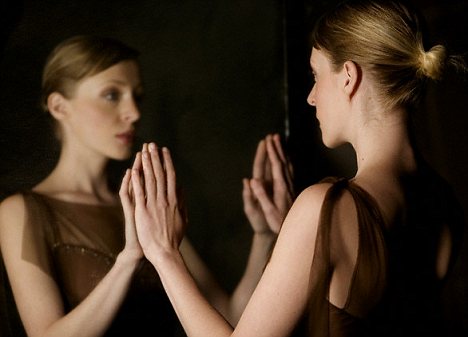
Mirror Ghost Girl

Woman Looking at Reflection

Something I’ve noticed over the past few months is a shift in how I manage physical dysphoria. For the past five years, after gaining a lot of weight which accentuated my female anatomy, I coped almost exclusively though avoidance: showering in the dark, avoiding mirrors, deleting photos of myself, wearing baggy clothes, etc, basically pretending that my body didn’t exist.

But after a rigorous workout routine for the last 8 months, I have lost weight and built muscle and restored some of the physical androgyny that made me feel more comfortable as a scrawny teenager. I am able now to tolerate seeing my body or my reflection or my image in photos with less disgust. With this has come a shift from avoidance to compulsive body-checking and self-monitoring. Instead of avoiding mirrors, I now find it extremely difficult to pull my eyes away from my reflection.

This fascination (or perhaps obsession) seems motivated partly by simple astonishment and gratitude that I can actually tolerate seeing myself. But it is also motivated by a constant effort to reconcile that body as my own, which feels completely incomprehensible and beyond my power of imagination. The person I see in the mirror – the face, the body, the clothes – is all very familiar and recognizable, but in the detached non-self way that a close friend’s or sibling’s appearance is familiar and recognizable. When I see myself in a photo or in the mirror, I often notice myself thinking, “I suppose if I HAD to have a female body and could choose to look like someone, maybe it wouldn’t be so bad to look like her.” And then I remind myself that I DO look like her, that it’s actually ME in the mirror or the picture. But my mind remains unconvinced, and I continue to stare at those reflections and images of myself with the unsettling mixture of curiosity, frustration, and disorientation that comes with trying to unravel a particularly puzzling optical illusion.

The other part of this is that when I see my reflection or even just look down at my body, my appearance seems to change dramatically within the space of just a few minutes or hours. Sometimes it looks like I’ve gained 20lbs since morning and in my mind I immediately start making sweeping restrictive changes to my diet, only to see myself later in the day with the impression of almost unhealthy leanness and then erase all the dietary changes I just made.

More often it doesn’t look like weight gain or loss, it seems instead like a generalized skeletal reconfiguration, like all the ratios and proportions of my body (waist to hip ratio, width of my shoulders, angles of my face) have shifted to create subtle but – to me – obvious and unsettling differences in my appearance. My image remains familiar and recognizable, but constantly different, like looking in the mirror and seeing various digitally altered versions of your friend or sibling. Even when I mentally account for the differences in clothing, lighting, mirror distortion, etc, I can still see very clearly all the structural changes in my appearance.

This feels like a new experience that has emerged in the past few months, probably because it has been so long since I was actually able to see myself without immediate revulsion and withdrawal. Sometimes I feel like I’ve gone completely insane… I know with certainty that it is not physiologically or anatomically possible for any human body to change that much in such a short period of time. I know this. I remind myself of that over and over. Yet what I keep seeing with my own eyes, right there in front of me, incontrovertible visual evidence, is this shape-shifting mirror-ghost of a body that I cannot imagine I actually inhabit.

“What a strange thing a mirror is! And what a wondrous affinity exists between it and a man’s imagination!”
– George MacDonald (Phantastes, 1858)

New York Times Trans Voices

The New York Times has an ongoing editorial series about transgender experiences (Transgender Today), with an online section for submissions from trans people to share their own stories (Trans Voices).

I found that most of the stories in that series described the experience of gender dysphoria in terms of social gender roles and traditional gender stereotypes, without much reference to the physical distress that is so prominent for me. The blog American Trans Man has an excellent series of posts describing body dysphoria (What Does Body Dysphoria Feel Like?), but I did not see my own experience represented there either.

So I wrote this piece in an attempt to describe my profoundly physical dysphoria, which was challenging within the 400 word limit. I submitted my story to the New York Times online in June 2015, however it was not accepted for publication. My original submission is below.

————

I am not a woman. And I do not know what it means to feel like a man. But I do know this: my brain believes my body should be male. I know this too: living with a female body is a thousand daily torments, a relentless rain of knife-sharp wounds, a constant cacophony of noise in my mind and a disorienting disconnection from my physical self.

An accidental glimpse of this girl-face in the mirror feels like a baffling optical illusion, an odd reflection of a face I know so well but can never quite call my own. The soft, hesitant, distinctly female voice that emerges from my mouth feels like some kind of cruel deception. The shape of my shadow, a perfect hourglass,  is a barbed and bitter insult. Menstruation brings with it a dark and bloody tidal wave of despair, an overwhelming urge to claw open my own abdomen and rip out the offending uterus with my bare hands. For years I have showered with the lights off so I don’t have to see this foreign female body naked, but even in the darkness I feel a surge of revulsion when my soapy hand slips between my legs or slides quickly over my chest. A kaleidoscope of images now… the absurd roundness of these girl-hips, the obscene feminine heaviness of my upper thighs, the fragile slenderness of my fine-boned hands, the ugly narrowness of my unmuscled shoulders, the terrible width of my flared iliac crests cradling a soft smooth belly, the raw red ring around my ribs from a too-tight sports bra… all inescapable, all excruciating, all wrong. WRONG! WRONG! WRONG! The same refrain always buzzing in my head, the same anxiety always crawling just below my skin.

All this I know, every minute of every day.

But I do not know what comes next. I am confused. I am terrified. I am drifting on a sea of fear and uncertainty, paralyzed by indecision. I feel a desperate urgency to make a choice, to finally find some peace.

Testosterone, mastectomy, hysterectomy. Those are the options that could tear my life apart. Those are the options that might mold parts of me into a more masculine form. But is that where I want to go? Will that ever be enough to stifle these sirens screaming in my brain? What does silence sound like?

————

“Take care of the sense, and the sounds will take care of themselves.”
– The Duchess (Alice’s Adventures in Wonderland, 1865)