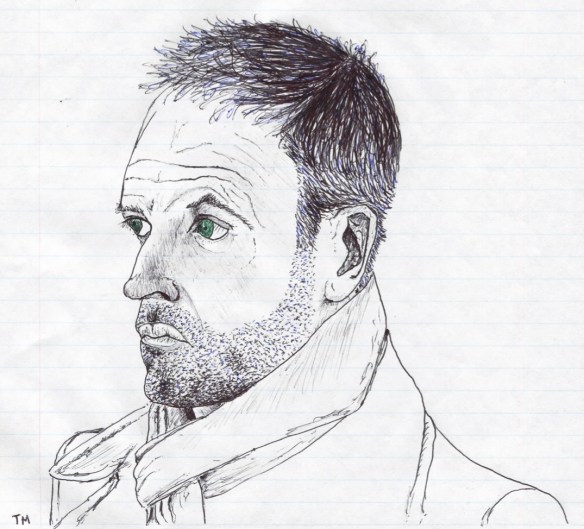
Portrait: Jonny Lee Miller (Sherlock Holmes)

miller-2

Materials: ballpoint pen (black, blue, green)

Time: 2 hours

Reference: Jonny Lee Miller as Sherlock Holmes in Elementary (2012 – ). Chose a face in semi-profile for more challenge, with short stubble to try a different texture. I will admit that I’m a huge fan of various book and television versions of Sherlock Holmes, and I think Elementary provides the most compelling characterization of Holmes and Watson.

Comments: pencil allowed for outer face shape only. No eraser. Facial proportions accurate. Shading smoother. Eyes and hair consistently the most enjoyable aspects of a portrait. I lost interest after finishing the face and decided not to darken his jacket.

miller-wip

“I mean, Watson, that I am an important part of your life. And you are an important part of mine. And even though we might draw further or nearer from each other depending on circumstance, you and I are bound, somehow.”
– Sherlock Holmes (Elementary: S03/E04, 2014)

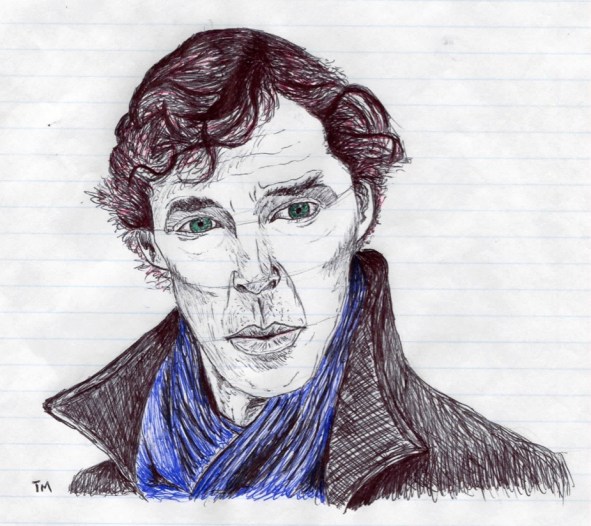
Portrait: Benedict Cumberbatch (Sherlock Holmes)

cumberbatch-1

Materials: ballpoint pen (black, blue, red, green)

Time: 90 minutes

Reference: Benedict Cumberbatch as Sherlock Holmes in BBC Sherlock (2010 – ). Chose Cumberbatch for his very distinctive facial features. Slight head tilt for challenge.

Comments: pencil allowed for outer facial shape only. No eraser. Facial proportions much more accurate than previous drawing. Shading still very rough. Satisfied overall, but considerable room for improvement.

cumberbatch-wip

“Heroes don’t exist. And if they did, I wouldn’t be one of them.”
– Sherlock Holmes (BBC Sherlock: S01/E03 – 2010)

Portrait: Robert Downey Jr (Tony Stark)

rdj-1

Materials: ballpoint pen (black, blue, red, green)

Time: 45 minutes

Reference: Robert Downey Jr as Tony Stark in Iron Man (2008). For simplicity, I chose a recognizable male face on straight angle with facial hair – adding more facial hair allowed relatively easy adjustments in lower face shape despite being unable to erase.

Comments: first completed drawing since 2011 and first human face ever attempted. No pencil, no eraser. It’s certainly not great – facial proportions somewhat distorted, shading very rough – but it’s a start…

rdj-wip

“We make our own demons.”
– Tony Stark (Iron Man 3, 2013)

Forever Incomplete

forever-incomplete

In a previous post, I mentioned that I used to draw. Most of my earlier artwork was done during high school from 2006 – 2008. I usually drew animals. I preferred colored pencils. I reluctantly tried different styles and different drawing materials (pencil, acrylic paint, watercolor, charcoal, ink etching) for art class assignments.

High school art class deadlines forced me to keep drawing frequently for three years, but after graduation I only finished a handful of pictures. Eventually, I completely stopped drawing. Art was simply too frustrating and too painful for me to continue. I was too perfectionistic for the process to ever be enjoyable. I would get so angry while drawing that my family often had to physically restrain me from tearing my work to shreds. Before I ever started a picture, I spent hours drawing a 1cm by 1cm grid on the reference photo and enlarging the grid proportionally on the blank white paper so that I could copy each detail meticulously. After the grid was complete, the drawing process felt like a never-ending series of mistakes that required constant erasing and smudging and adjustment. So I hated drawing. But I felt compelled to do it because I received so many compliments on the end results.

My last attempt at drawing was during second year vet school in 2011. It was a picture of a cow and her calf, shown above, intended as a gift for one of my professors. I became so enraged halfway through the drawing that I tore up the reference photo and threw my box of colored pencils across the room. After cleaning up the scattered paper fragments and shattered rainbow lead, I stuffed the half-finished picture back in a folder and promised myself I would never draw again. That drawing will remain forever incomplete. And I was artless for the next five and half years.

In all my previous artwork, I had never drawn people. Partly because I assumed I would never have the skill to draw a person perfectly. But mostly because I was so uncomfortable with my own appearance – discomfort arising from gender dysphoria and resulting in anorexia – that I refused to consider any attempt at drawing a human face or body. But I harbored a secret desire to be able to draw portraits with enough skill to capture a person’s resemblance and facial expression.

During my time on the psychiatric unit over the past few months, I finally decided to try drawing again. But I knew I had to do something differently to avoid returning to the same frustrating perfectionistic habits. And following the radical improvements in body image, I wondered if I could now try drawing people. So I broke all my old rules.

No pencil. No eraser. No grid. No animals.
Human faces. Drawn freehand. With pen.

This process has been far more enjoyable than I ever imagined. I now find myself looking forward to drawing with more excitement that I ever believed would be possible for me. I think my portrait efforts are a reflection of my progress in creating a more positive perception of my current appearance. And, in some ways, these portraits have been very helpful in contributing to acceptance and appreciation for human faces, including my own.

My drawings have become an incredibly important aspect of how I cope with body dysphoria, so I will start posting them here on Genderland. This ongoing active acceptance of my appearance is a process that will remain forever incomplete.

“Every portrait that is painted with feeling is a portrait of the artist, not of the sitter.”
– Basil Hallward (The Picture of Dorian Gray, Oscar Wilde, 1890)

Ambiguous Androgyny (Part 3): What You See

————
Part 1: Recognizing an Optical Illusion
Part 2: Deconstructing an Optical Illusion
~ Part 3 in the Ambiguous Androgyny series ~
————

now-you-see-me-4

Following the radical shifts in perspective after the mirror experiment, I have been working through several new considerations.

The first consideration is an important caveat: all of these recent realizations – a more positive and more realistic body image, a concrete image of my ideal body to help guide transition choices, and increased gratitude and acceptance for my body – all of these realizations apply very specifically to my body as it currently exists. Had I attempted that mirror experiment at any other time over the past 10 years, I think I would have aborted the attempt within a few minutes because the disgust, self-loathing, and confusion generated by seeing my mirror reflection would have been intolerable.

But now, I am fitter, stronger, and physically healthier than I have ever been before. This is not to suggest that accepting your body is only possible if you meet externally imposed standards of fitness or conform to conventional expectations of attractiveness. Absolutely not. I am only saying that the increased muscularity and decreased body fat associated with a rigorous exercise routine are changes that have allowed me to finally feel comfortable in my own body.

This also is the first time that I have achieved a degree of androgyny sufficient to alleviate most of my physical dysphoria while also maintaining a healthy body weight. This is not to suggest that expression of androgyny excludes bodies that are thinner or heavier than mine. Absolutely not. I am only saying that finding a way to create a comfortably androgynous appearance for myself, without resorting to a dangerously low body weight, is a much healthier and more sustainable approach than my teenage anorexia.

I think it is also important to acknowledge that much of my gratitude for my current body comes from realizing that I have won the genetic lottery. As an XX individual, I consider myself incredibly lucky to have a body that is capable of looking this androgynous without medical or surgical intervention so far. I have made considerable effort, through my workouts and my diet and my clothing choice and my haircut, to create this appearance. But that effort is only one small part of the story. I am lucky that I have the metabolism to lose weight relatively easily and maintain low body fat. I am lucky that I have the anabolic capacity to build muscle mass fairly easily in response to the effort I put in at the gym. I am lucky that my facial features are naturally androgynous. I am lucky that my chest has always been flat and has become even flatter after thousands of pushups and thousands of bench press reps. I cannot take credit for those factors. I can only be grateful for them.

The second consideration is that maintaining my body in a way that feels comfortable for me will require consistent ongoing effort. I have several options about what kind of effort this might be. I could continue my current diet and exercise routine. I could proceed with medical options including testosterone and mastectomy. I could work towards greater internal acceptance of the aspects of my body that I cannot control. All of these possibilities represent ongoing effort. All of these options come with advantages and disadvantages.

My daily workouts require a considerable investment of time and energy. Having started a new combination of medications to manage the debilitating fatigue of depression and having adjusted my lifestyle to incorporate an early morning exercise routine, the time and energy costs are no longer prohibitive barriers.

My diet requires constant awareness of calories, grams of protein, grams of fat. My diet also requires active tolerance of the often intrusive nature of this awareness. Many of my food-related thoughts and behaviors are habits deeply ingrained from a decade of disordered eating, and I do not recommend these strategies to anyone else. But I have accepted that these thoughts and behaviors are unlikely to disappear entirely. And while I don’t think the improvements in body image will lead to any immediate changes in my approach to food, these thoughts and behaviors become much more tolerable in the context of acceptance and gratitude instead of disgust and self-loathing.

Now that my ideal body is more clearly defined in my mind, I feel better able to evaluate the many different options for testosterone moving forward. Because I have realized that my goal is not complete physical masculinization but rather minor masculinizing adjustments to my current body, I think I would prefer to start on a low dose of testosterone so that physical changes occur very gradually. At this point, I have one particularly prominent question: In an XX person, would long-term administration of low dose testosterone ultimately lead to complete physical masculinization, but at a much slower pace than higher doses of testosterone? Or would long-term administration of low dose testosterone lead to partial masculinization that would be sustainable and non-progressive past a certain point? I am hoping very strongly for the latter. I have started looked for published data to answer this question, but so far I have only found articles describing the effects of chronic administration of high doses of testosterone in FTMs or describing the effects of short-term administration of low doses of testosterone in women (including the effects of exogenous testosterone administered to treat various medical conditions as well as the effects of endogenous testosterone in women with polycystic ovarian syndrome). However, there seem to be no studies describing the effects of long-term administration of low dose testosterone in female-bodied people without concurrent medical issues. I have only found a handful of anecdotal descriptions on personal blogs from trans people taking low doses of testosterone. But this is an important question for me, so I will continue my investigation.

The third new insight is that greater acceptance and comfort with my how my body LOOKS has been followed by much greater awareness of how my body FEELS. Prior to the mirror experiment, I was so detached from my body that I had very little awareness for how it felt. When prompted by my psychiatrist to identify physical sensations associated with certain emotions, I was completely unable to do so. The only time I ever felt any meaningful physical awareness was during exercise, as I have described with respect to running and boxing.

But since that mirror experiment, I seem to have developed an intensely heightened awareness of so many daily physical sensations. A shower used to be just a shower. Now a shower is a thousand individual drops of water, each one hitting my skin and trickling down my body. Applying hand lotion used to be just a necessary task. Now I am aware of how the knuckles and metacarpals and tendons of one hand feel inside the palm of my other hand. Clothing used to be just a set of pants and shirts and underwear. Now I am aware of how different types of fabric feel against my skin, aware of the pressure as a shirt stretches across my shoulder, aware of the gentle tension of cuffs around my wrists. Going outside used to be a retinal adjustment from dark hallway to sunny doorway. Now this transition is not just a visual adjustment but also a physical awareness of the change in temperature from hallway to door, an awareness of how the shadows feel when they dance across my skin as the sunshine chases them away. Waking up in the morning used to be an abrupt termination of a dream replaced by real-life thoughts. Now waking up is an immediate awareness of my whole body stretched out on the mattress, an awareness of the light weight of sheets and blankets surrounding me.

“You used to be much more… muchier. You’ve lost your muchness.”
– The Mad Hatter (Alice’s Adventures in Wonderland, 1865)

I really can’t describe this feeling any better than The Hatter. Being inside my body now is much more muchier. There’s so just much muchness.

I had been living with my parents before I was admitted to hospital but was unable to move back in with them after discharge, so one of the priorities was finding a place to live after discharge. Up until the mirror session, I had been thinking only in terms of apartments and rent and location. But now, I finally understand that I can live HERE, in my own body. It feels like authentic inhabitation of a home I didn’t even realize that I had.

The last new realization is also the most powerful. I previously described watching how women shift their interpretation of my appearance from male to female when they see me in public washrooms. I recently had the opportunity to observe this perceptual reversal in a dentist’s waiting room instead of a womens’ washroom.

I sat down in the waiting room to fill out a general history form, which required that I list my current medications. An elderly man sitting nearby saw me writing and said, “Whattaya doin’? Writin’ down the names of all your girlfriends?” His tone and posture seemed to suggest that he was making a conspiratorial joke, but I did not find his questions humorous at all. I was annoyed by the interruption, astonished by his presumption, and curious about his assumptions.

I was wearing jeans and a loose-fitting blue sweater, with my backpack on the floor beside me. I thought it most likely that his attempted joke hinged on the string of assumptions that I am male, straight, teenage, and obsessed with girls. I also considered the possibility that he perceived me as female and assumed that I am lesbian because I have short hair. I won’t list all the problematic stereotypes associated with those assumptions, but I will say that I have encountered all of them on multiple occasions before.

I continued writing without looking up from the page, and said, “No, I’m writing down my medications.” And then, because I was both intensely curious and intensely irritated, I looked up and asked him, “Do you think I’m male or female?” He frowned, and I watched his eyes roam up and down my body, eventually returning to my face. He finally said, uncertainly, “Ooooh… I guess… you’re actually female?” So it seems that he had indeed made that first series of assumptions: male + straight + young = girl-crazy. And while his assumption that I was a boy provided some validation of my physical androgyny, his comments also demonstrated incredible ignorance. So I shrugged, unwilling to definitively confirm either maleness or femaleness. But because he now saw me as female, I said, “Doesn’t mean I don’t have girlfriends.” He let out a short uncomfortable chuckle, and then stood up and moved to the chair as far away from me as possible.

And you know what? I did not feel the slightest hint of guilt about being the source of his discomfort. Nagging guilt about the discomfort that my appearance causes other people has plagued me in the past. But not anymore. Because I have achieved not only an authentic inhabitation of my body, I have also achieved an authentic acceptance of my ambiguous androgyny.

This here? What you see when you look at me?
This is not a deliberate deception.
This is not an intentional illusion.
It is authentic ambiguity.

It is not a palmed card.
It is not a crafty shuffle.
It is not a false cut.
It is an ace worn proudly on my sleeve.

now-you-see-me-1

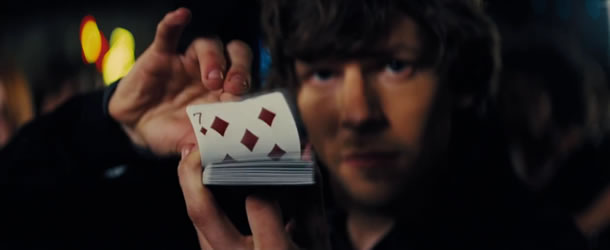
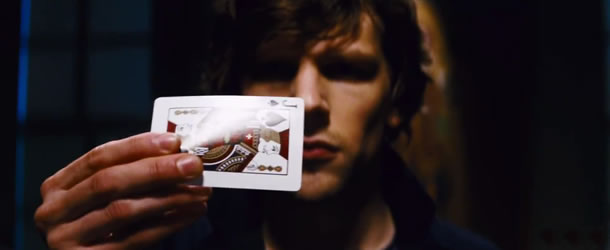
“So come close. Get all over me. Because the closer you think you are, the less you’ll actually see.”
– J Daniel Atlas (Now You See Me, 2013)

Reflection on Reflection #2

Reflection on Reflection #2

With your sheets like metal and your belt like lace,
And your deck of cards missing the jack and the ace,
And your basement clothes and your hollow face,
Who among them can think he could outguess you?
With your silhouette when the sunlight dims
Into your eyes where the moonlight swims,
And your match-book songs and your gypsy hymns,
Who among them would try to impress you?

– Bob Dylan
(Sad-Eyed Lady of the Lowlands, 1966)

Reflection on Reflection #1

Reflection on Reflection #1

“There are things known and there are things unknown, and in between are the doors of perception.”
– uncertain origin*

————

*Commonly attributed to Aldous Huxley.

This quote does not actually appear in Huxley’s work but is often assumed to originate from his book, The Doors of Perception (1954). The Doors of Perception is a philosophical essay reflecting on the experience of taking mescaline, titled in reference to a statement from William Blake: “If the doors of perception were cleansed, everything would appear to man as it is, infinite.” (The Marriage of Heaven and Hell, 1790).

The American rock band The Doors was named in reference to Huxley’s book. The quote above has also sometimes been attributed to co-founding band members Jim Morrison and Ray Manzarek, although it was likely abbreviated from a comment made by Manzarek in an interview for Newsweek: “There are things you know about,” says 25-year-old Manzarek, whose specialty is playing the organ with one hand and the bass piano with the other, “and things you don’t, the known and the unknown, and in between are the doors – that’s us. We’re saying that you’re not only spirit, you’re also this very sensuous being. That’s not evil, that’s a really beautiful thing. Hell appears so much more fascinating and bizarre than heaven. You have to ‘break on through to the other side’ to become the whole being.” (Newsweek, 1967, This Way to Egress)

It is unclear who rephrased Manzarek’s statement into the wording displayed above, or why this quote is most often attributed to Huxley despite not appearing in his published work. This is one of those things unknown.

Ambiguous Androgyny (Part 2): Deconstructing an Optical Illusion

————
Part 1: Recognizing an Optical Illusion
~ Part 2 in the Ambiguous Androgyny series ~
Part 3: What You See
————

The Prestige

“Are you watching closely?”
– Alfred Borden (The Prestige, 2006)

In my last post, I discussed how the analogy of an optical illusion – specifically, the multistable perception that arises when viewing ambiguous images – has given me a more concrete framework to understand my experience of body dysphoria. Optical illusions have been described as an experience where “expectations are violated”, so I had challenged myself:

Does this multistable perception of my mirror image indicate the presence of some problematic expectations that my ambiguous androgyny somehow violates? Is it possible for me to deconstruct this distressing optical illusion to create a more comfortable, more coherent, and more stable cognitive interpretation of my physical appearance?

Certainly, part of the optical illusion effect comes from gender dysphoria itself. The inexplicable but undeniable distress I feel in response to seeing my female anatomy, and the detachment from my physical appearance that developed as a means to cope with that distress, both contribute to difficulty recognizing my mirror image as an accurate reflection of myself.

But now I think there was a second layer to that illusion: my own expectations about what male and female bodies are supposed to look like. My physical androgyny, deliberately designed to minimize female traits and partially successful in reducing the intensity of body dysphoria, became an optical illusion because it did not match conventional expectations of “male body” or “female body” and generated mutually exclusive alternating interpretations of “boy” or “girl”. “The perception of multistable stimuli can be influenced by contextual properties of the image, including recognizability and semantic content.” (Leopold 1999) My ambiguously androgynous mirror reflection became an illusion by violating my gendered-body expectations and refusing to align with any recognizable gender pattern in my mind.

Which leads to the third layer of this illusion: the insidiously deceptive illusion of opposites. For so many years, I assumed that because my brain did not expect to see a female body, it must expect to see a male body instead. This was an appealing and self-reinforcing assumption because a “male” body is a concrete and easily visualized image. Dozens of male bodies cross my sightline each day. My mind catalogues all their physical similarities, an additive assimilation of biased data to create an increasingly narrow idea of what makes a man a man. This process provoked a constant self-loathing comparison of my female body to their male bodies and a vicarious idealization of stereotypical physical masculinity.

A couple of months ago, I had several long conversations about my ongoing disordered eating issues and my experience of body dysphoria with a new acquaintance. When I described the optical illusion effect associated with seeing myself in the mirror, he asked, “Would it be helpful to spend longer looking at yourself in the mirror, to try to acclimatize your mind to the mirror image?” I immediately dismissed his suggestion, telling him that spending more time in front of the mirror would only prolong the uncomfortable optical illusion sensation.

But over the next few days and weeks, I found my mind continually returning to his question. Everything I hear, every word I read, everything I see – all of it, all the time – it just keeps echoing around in my brain like a constant cognitive echolalia. Questions always echo loudest.

“Would it be helpful to spend longer looking at yourself in the mirror?”

 “…spend longer looking at yourself in the mirror?”

 “…yourself in the mirror?”

I started to reconsider my original dismissal. I tried to imagine spending a longer period of time in front of the mirror. Anticipating the same discomfort and confusion that has always plagued my reflection, I remained rigidly resistant to this prospect. Until I finally realized: I don’t need to look at my reflection LONGER, I need to look at it DIFFERENTLY. I should stop trying to force the optical illusion into a logical conclusion. Instead, I need to try to see past the deception and reveal my brain’s expectations. I should stop letting myself get distracted by the magician’s misdirection, lulled over and over into seeing the impossible while knowing that it is impossible. Instead, I need to ignore the magician’s diversions and focus on the cold hard mechanics of the trick to see how it’s actually performed.

So began the mirror experiment. With an odd mixture of anxiety and curiosity, I propped myself cross-legged on the stainless steel shelf across from the mirror in my hospital bathroom. I stared at myself in the mirror for an hour.

The first few minutes in front of the mirror were dominated by self-judgment. I felt so obnoxiously vain – with respect to Greek mythology, such intense focus on my reflected image is practically the definition of narcissism. But I was able to rationalize it by reminding myself that someone else had suggested this mirror experiment. After I let go of that self-judgment, the insights that arose during my time in front of the mirror were incredibly enlightening and completely unexpected.

As I stared at my reflection, I intentionally kept changing the lens through which I viewed my mirror image. I started with a third-person lens, trying to see myself neutrally, objectively, as an outsider. I wondered: What does my psychiatrist see when he looks at me? What do my friends see? What do strangers see? I revisited echoes from previous conversations, comments other people had made about my physical appearance.

“I see you as female right now because I’ve read your file and I know your age. You’re 24. But you don’t look like a 24-year-old man… probably based on the lack of facial hair. So if I just saw you on the street and didn’t know your age, I would assume you were an adolescent boy.” – a psychiatrist

“You think 80% of strangers read you as female and 20% read you as male? I dunno, McMurray… I think it’s closer to 50-50. Or maybe 60% would say you’re female, 40% male. There have been several times when we’ve had coffee where someone comes up to me after you’ve left and asked “Who was he?” or asked if you were my son.” – a friend

“Hey. I just wanted to say… you look so good in that tank top! Like, your shoulders are so jacked! Oh my god, I wish I had arms like that.” – an in-patient on the psychiatric unit

“Don’t take this the wrong way… but… your perception of yourself as ugly or unattractive is not exactly accurate… I think that might be an unrealistic and negative distortion. At least from my perspective.” – an acquaintance

Hearing those echoes and seeing the person in the mirror through this third-person perspective was like seeing an engaging snapshot of a stranger, appreciating their appearance and finding yourself curious about who they are and what their life is like. Such strict objectivity was surprisingly reassuring.

I mentally hit ⌘S to save an image of that objective snapshot, then discarded the third-person lens, toggled the microscope, slotted in a first-person filter, and reattached my “self” to the body in the mirror. As my first-person perspective came into focus, I felt the familiar flutter of distressing dysphoric confusion, but I hit ⌘S again. Then I opened up two Preview windows side-by-side to compare the third-person and first-person images.

Prior to this mirror session, I didn’t think that I had a distorted body image. I thought I saw myself realistically and just didn’t like what I saw. But this direct comparison of two different perspectives on my appearance illuminated several previously unrecognized negative distortions. I am not actually not as homely as I always thought, I am leaner and more muscular than I thought, I look physically fit and healthy. These realizations came with a deep sense of gratitude for my body and a brand new desire to treat this body kindly, no matter which gender its appears to be.

This direct side-by-side comparison also revealed a troubling cognitive sleight-of-hand: whenever I see myself, my mind immediately hones in on female anatomy and magnifies the size and significance of these female features while largely ignoring other aspects of my appearance. Being able to see myself in the third-person image without the mentally Photoshopped enhancement of physical femininity finally allowed me to appreciate how small and insignificant these female anatomical traits are on my own body.

The next step was to return to the original challenge I had set for myself: examine my expectations. I adjusted the microscope once more, retaining the first-person lens but changing the position of the focus to visualize the expectations underlying the outward appearance. It’s obvious that I do not expect to see a female body in the mirror, but do I really expect to see a male body instead? That’s an easy assumption, but is is accurate?

I have struggled for so long to create a tangible idea of my transition goals. Considering making masculinizing modifications to my body has always seemed appealing, but those options come with risks and side effects and I have been unable to clearly visualize the final outcome of these steps. So I have been overwhelmingly uncertain to what I extent I want to medically transition.

With the focus on my expectations, I opened up a third window in my mind: a CGI animation program. I imported the objective third-person image of myself and translated that into a 3D avatar that represents my current body. Then I started building an avatar to represent my “ideal” body. To do this, I had to disable the program’s automatic preset templates for “male” or “female” characters – templates generated from internalized expectations of what “men’s bodies” and “women’s bodies” are supposed to look like, expectations accumulated after nearly two and a half decades in a world that revolves around binary gender stereotypes. Without a 2D image or a preset template, I had to start from scratch on my “ideal” avatar, first building a basic genderless human body and then adding and subtracting anatomical features (a beard, a penis, a square jaw), adjusting ratios and proportions (broader shoulders, bigger deltoids, narrower hips), until my “ideal” avatar finally emerged with a startlingly concrete clarity. My “ideal” body seems to be one of nearly symmetrical androgyny: a lean and physically fit individual with moderate upper body muscle mass (prominent but not bulky), a smooth chest, a shoulder-to-hip ratio of about 1.2 to 1.4, a waist-to-hip ratio of about 0.8, and a well-defined jawline. Beard and penis not required.
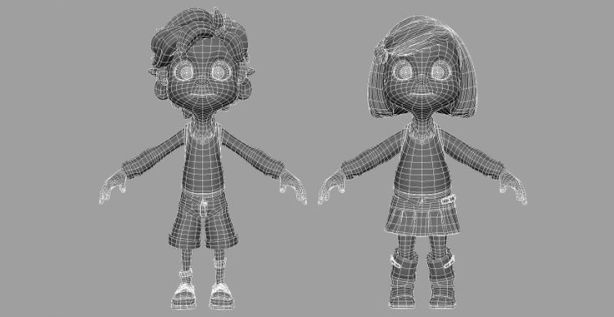
3D Character Model

Having created realistic 3D models of my current body and my “ideal” body, I aligned these two avatars side-by-side on the screen. I reduced the opacity of both images to about 50% transparency and dragged the “ideal” avatar over top of the “current” avatar. And then I looked for discrepancies, trying to figure out where the two avatars differ. To my astonishment, it became clear that the differences between my real body and my ideal body are far more minor than I had previously believed! My ideal body has a slightly more masculine silhouette than my current body (broader shoulders, more upper body muscle mass, wider waist, narrower hips) and slightly more masculine facial features. Otherwise, my real and ideal avatars are almost identical.

This realization was profoundly reassuring. I finally have a concrete mental image of what I want my body to look like in the future – I have an avatar to project forward in time. I also have a much more positive and more realistic perspective on my current body, a much more authentic acceptance of my current appearance, and an overwhelming gratitude for my body. My androgynous appearance no longer seems ambiguous, because I no longer have to force it to align with expectations about what men and women look like. My androgynous appearance is now unambiguously, unequivocally, unashamedly my own. “In addition to being associated with perceptual transitions during multistability, activity in frontal and parietal cortex can also contribute to percept stabilization.” (Sterzer 2009) I think these cognitive contortions through the looking-glass have finally stabilized my perception of my mirror image in a way that could be comfortable and consistent over time.

My mind lingered for a few more moments, visualizing my real and ideal avatars, regarding them both with dawning respect and gratitude and affection, feeling a growing groundedness inside these bones and vessels and muscles that are my home for life. And then, ⌘S one more time – these images are worth saving, remembering, cherishing – one by one I closed all the windows I had opened in my mind. After the software was shut down, the microscope dismantled, the lenses stowed away, I found myself with nothing left between me and my mirror image. And it was in that one raw unguarded moment that I realized: I DON’T WANT TO KILL HER. I had just spent a very intimate hour with this girl – I had seen every subtle change in her expression, seen tears of gratitude welling up, watched a bemused little grin flicker across her face, I had watched her body shift and stretch, had seen the athletic strength and flexibility behind even the smallest adjustments in posture – and I could not bear the thought of killing her. Reattaching my “self” to that thought, I realized: I DO NOT WANT TO KILL MYSELF. More than two years of suicidal ideation – varying in urgency and intensity but relentless in its constant haunting presence – evaporated in that single second. Just like magic.

“Every great magic trick consists of three parts or acts. The first part is called The Pledge. The magician shows you something ordinary: a deck of cards, a bird, or a man. He shows you this object. Perhaps he asks you to inspect it to see if it is indeed real, unaltered, normal.

The Pledge is my female body: real, ordinary, medically unaltered.

 The second act is called The Turn. The magician takes the ordinary something and makes it do something extraordinary. Now you’re looking for the secret… but you won’t find it, because of course you’re not really looking. You don’t really want to know. You want to be fooled.

For years, my brain was stuck at the Turn, constantly creating illusions without really looking, desperately wanting to fool itself into seeing a body that matched my unchallenged expectations. I finally made those expectations disappear.

But you wouldn’t clap yet. Because making something disappear isn’t enough; you have to bring it back. That’s why every magic trick has a third act, the hardest part, the part we call The Prestige.”
– Cutter (The Prestige, 2006)

And now I’ve brought something back: a realistic perception of my female body, stripped of illusion and expectation, gently wrapped in gratitude and acceptance.

My body is my Prestige.

Abracadabra.

Prestige On Stage

————

References

Leopold DA, Logothetis NK. Multistable phenomena: changing views in perception. 1999. Trends in Cognitive Sciences 3(7):254-264. 

 Sterzer P, Kleinschmidt A, Rees G. The neural bases of multistable perception. 2009. Trends in Cognitive Sciences 13(7):310-318.